

By Dave Matlow
While there was a slight uptick in the number of Westport demolition permits issued in 2017 over the previous year, the five-year trend is definitely down — by almost 30 percent.
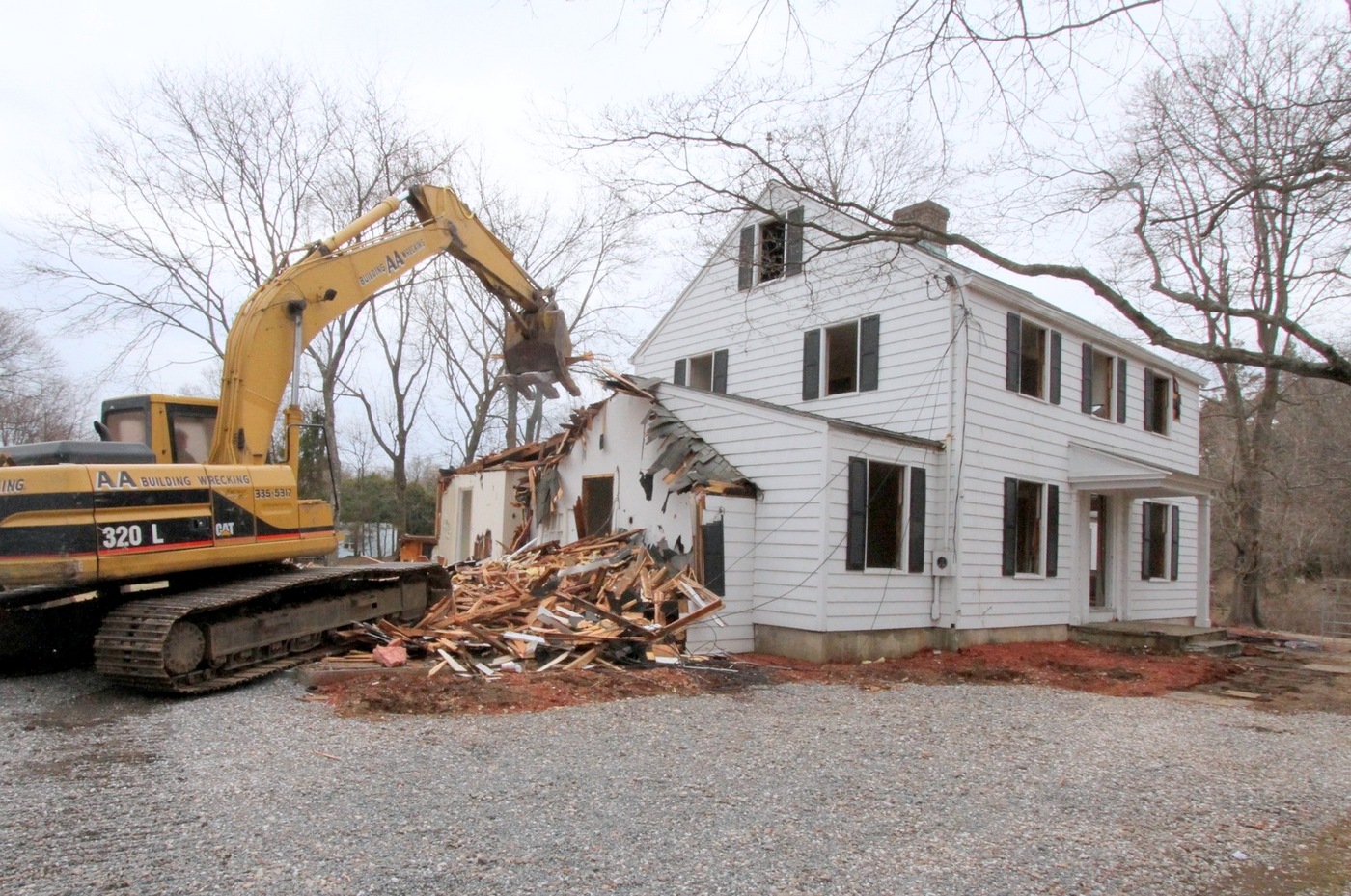
Westport teardowns have slowed due to a variety of reasons, including a new supply of “gently used houses.” (CLICK TO ENLARGE) Dave Matlow for WestportNow.com
And a local builder says the reasons are pretty clear — oversupply of homes on the market, longer train commutes, including more traffic jams getting to the train stations, more local government regulations, and unrealistic price expectations on the part of selling homeowners.
The figures tell the story. The Westport Building Department said in 2013, 107 demolition permits were issued. The next year, 2014, saw an increase to 124, but 2015 saw a drop-off to 104, then an even bigger fall in 2016 to 68, and a finally a slight increase in 2017 to 76.
Rob Haroun, owner of Westport-based SIR Development and one of the more active builders in Westport, also cited a new supply of “gently used houses” that are now on the market.
“This category includes homes that were built only 5 to 10 years ago to owners who now want to downsize, resulting in placing their houses on the market,” he said.
Prospective buyers of new houses more often find these houses an acceptable alternative to purchasing a newly constructed house, Haroun said.
Also, he added, there was a construction binge in two recent periods, 2006 to 2008 and 2012 to 2014 that added to the oversupply.
According to Raveis real estate agent Bob Weingarten, the breakdown of the current inventory of Westport houses on the market looks like this:
Under $ 1 million 69 houses
$1 million — $2 million 120
$2 million — $3 million 64
Above $3 million 41
Haroun said “the lack of political leadership” in the transportation area has reduced the number of prospective buyers. He said failure to invest in infrastructure is having an impact.
As an example, he said, commuters are less interested in Westport’s Coleytown area because traffic jams result in a 20-minute commute each way to and from the train station.
And, in addition, he said, the trains are slower. As a result he said millennials in particular are seeking properties closer to New York City such as Greenwich and Old Greenwich.
Government regulations are also impacting the market, Haroun said. “In the past three or four years, zoning, conservation, and construction restrictions have made things more cumbersome for developers,” he said.
As an example, he cited disallowing grading within 25 feet of a new house and the new requirement of a 50-foot setback in some areas compared to the prior regulation of a 35-feet.
New building codes have also added another level of construction complexities, Haroun said.
Developers are also challenged by a new hurdle — property owners who expect a higher price for their property by comparing it to the price of a neighbor’s property which sold for a specified amount several years ago.
“The sellers are thinking in the past,” he said. “New house prices have dropped during recent years.” Therefore, the increased purchase price for a lot for demolition, its higher cost of replacement construction, combined with fewer prospective buyers all make less sense economically for the developer.
As a result there is an overall environment of fewer sellers combined with fewer buyers and that has lead to the overall reduction of applications for demolition permits, Haroun said.


