

By James Lomuscio
Even with the Westport school system’s stellar reputation as a “lighthouse district,” school administrators are ratcheting up the curriculum here to prepare students to compete globally as thinkers, innovators, entrepreneurs and leaders.
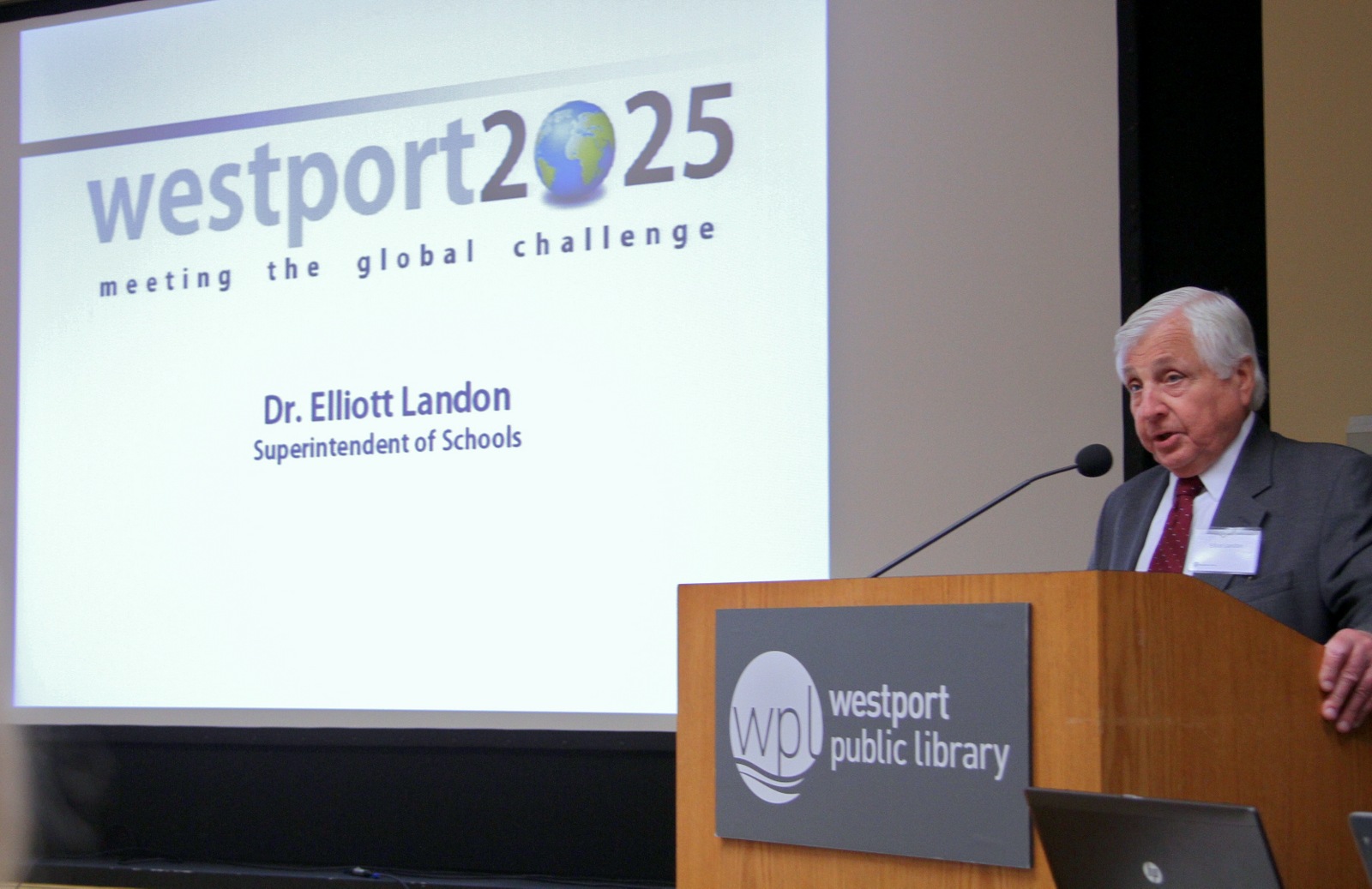
Schools Superintendent Elliott Landon addresses tonight’s meeting at the Westport Public Library. (CLICK TO ENLARGE) Dave Matlow for WestportNow.com
That was the thrust of “Westport2025: Meeting the Global Challenge,” a presentation that drew 40 parents, school board members and the curious to the McManus Room at the Westport Public Library tonight.
“We recognize that we in the United States are at a disadvantage when you look at countries like China and Finland,” said Schools Superintendent Elliott Landon, who launched the Westport2025 initiative.
“But we are a lighthouse district,” he added, noting that other school systems often look to Westport to follow its lead on successful educational approaches.
To that end, Landon has put together a task force of 40 teachers and administrators, who, working with educators from Columbia University’s Teacher’s College, are reevaluating all kindergarten through 12th grade curricula to sharpen students’ thinking skills to solve real work problems, he said.
Landon was joined in his presentation by Lisabeth Comm, director of secondary education, research and professional development, James D’Amico, chairman of of the social studies department for grades 6 to 12, and Janna Bell, principal of the Coleytown Elementary School.
Landon has said that the year 2025 holds special significance since that is when this year’s kindergartners will graduate high school.
Comm said that the task force is focusing on “seven survivor skills” for the 21st century delineated by Tony Wagner, co-director of the Change Leadership Group (CLG) at the Harvard Graduate School of Education.
According to Comm, those skills are: critical thinking and problem solving; collaboration and leading by influence; initiative and entrepreneurship; effective oral and written communication; assessing and analyzing information; and curiosity and imagination.
“This year we’re focusing on critical thinking grades K through 12,” she said. “You’re constantly getting kids in every classroom to stop and think.”
Even in the early grades, often initiated by the teacher, students are encouraged to ask “where’s the evidence” or say “that doesn’t make sense” so that they will think about what they have been told, Comm said, not merely parrot it back.
Young students do this by a practice known as “red light,” in which the term is used to stopping and question.
Comm’s comments were followed by a video “Changing the Paradigm,” in which internationally renowned educator Sir Ken Robinson talked about divergent thinking, often discouraged in an academic setting, as having a capacity for creativity and problem solving.
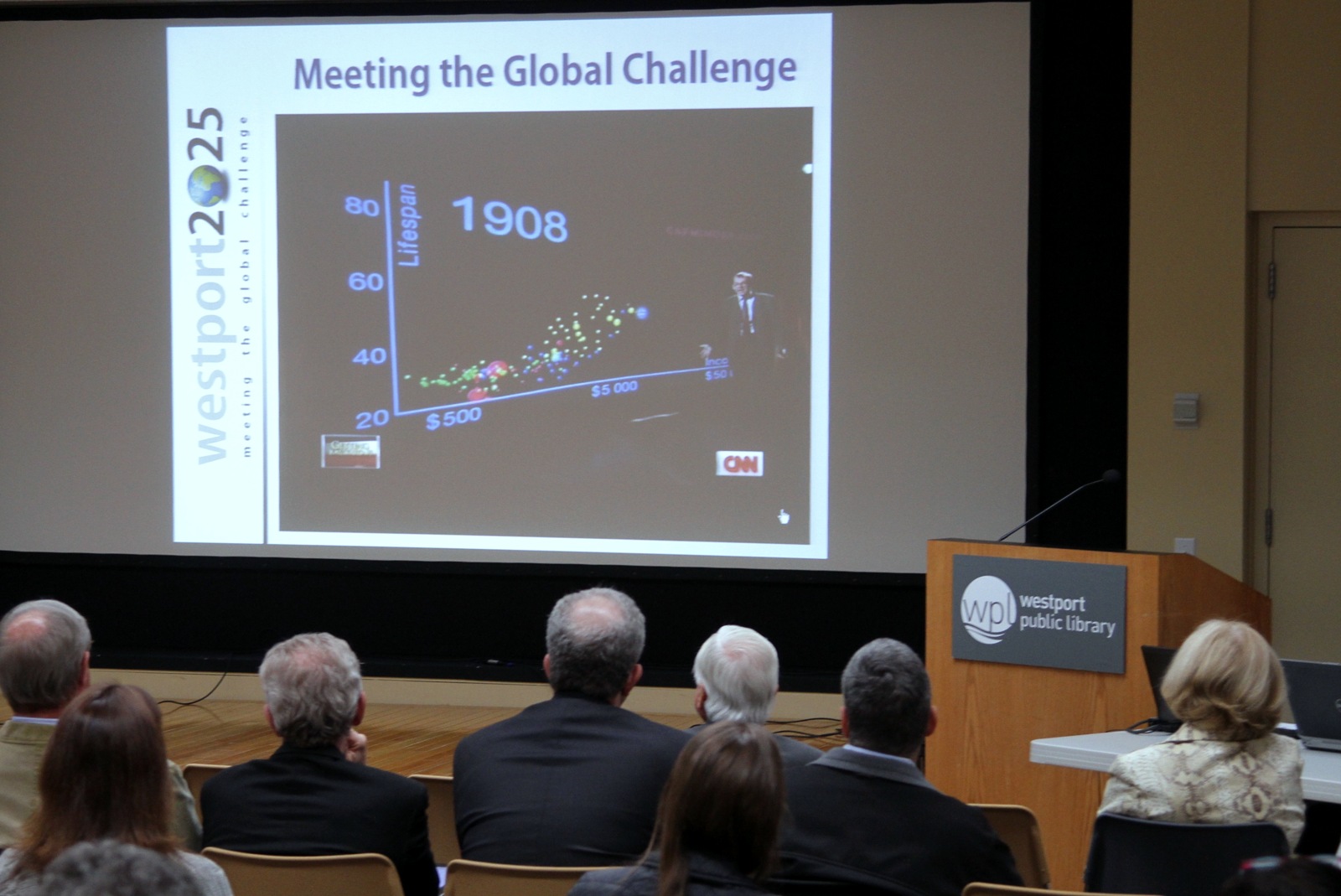
Attendees watch a video at tonight’s Westport2025 event. (CLICK TO ENLARGE) Dave Matlow for WestportNow.com
When it comes to divergent thinking, Robinson posits, 98 percent of all kindergartners are at the genius level, a level that drops precipitously in later grades as divergent thinking is stifled by a “factory model” of education.
Bell, who has introduced Singapore Math at Coleytown this year, stressed the importance of math as “making thinking visible.”
“We’re trying to challenge students to see math in the world around them,” she said, noting that equations are always backed up by visuals so that mathematics becomes “conceptual, not algorithmic.”
D’Amico spoke about the “interdisciplinary approach to social studies,” and how the study of current international affairs can bring together science teachers to talk about the effects of, for example, strip mining, and how and English teacher would talk about effectively organizing the ideas into a powerful essay.
“I have a sixth grader, and I’m very pleased with what they’re doing, and I’m very pleased with the presentation,” said Helen Glenn at the talk’s conclusion.
School board member Jim Marpe and former board member and past chairman Steve Halstead also gave the presentation high marks.
“If you look at the goals of the Board of Education in the 1990s, it was to prepare students to be successful in the 21st century,” said Halstead. “This has been a journey.”
“It’s a continuous journey and a district position for years,” said Marpe. “What you saw tonight was the superintendent’s initiative, and we’re very supportive.”


