

By James Lomuscio
The conversations today focused on the power of art and how it intersects with social change.
_.jpg)
Westport graphic artist Miggs Burroughs (l) talks to Mark Yurkiw, an astrophysicist turned “artrepreneur.” (CLICK TO ENLARGE) Contributed photo
The fifth annual, Westport Arts Advisory Committee (WAAC) TEA Talk — the acronym stands for thinkers, educators and artists — featured three, 20-minute conversations with professionals who use art to propel social causes. And their discussions kept attendees rapt in the nearly filled auditorium at Town Hall.
The first talk showcased Westport graphic artist Miggs Burroughs talking to Mark Yurkiw, an astrophysicist turned “artrepreneur,” as his calls it.
“Art is about problem solving to me,” Yurkiw said. “It’s much more relevant as I get older.”
Among his works shown on screen was his depiction of a freezing, huddled Statue of Liberty he created for the New York Cares Coat Drive, an image that proved so powerful in evoking emotion that “a few years ago the millionth coat came in,” said Yurkiw.
Another was a short film he did titled “Chelsea Cinderella.” It addresses the empowerment of women as they head out to become successful in New York City.
“There’s magic when art is applied to a purpose,” Yurkiw said.
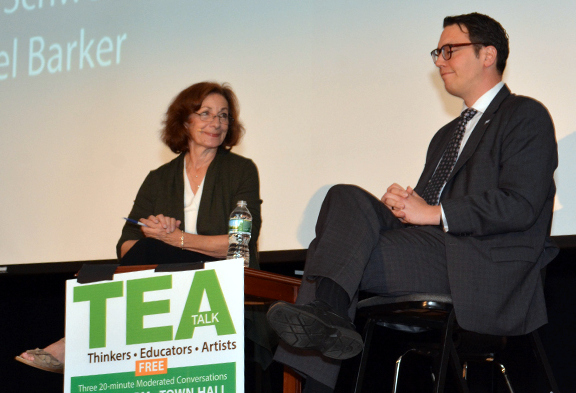
Carole Schweid interviews Michael Barker, Westport Country Playhouse managing director. (CLICK TO ENLARGE) Contributed photo
His comment seemed most fitting when one stared at the photos of his giant sculptures of solar-powered fireflies lighting up the conservatory rooftop of the Liberty Science Museum in New York Harbor.
The next conversation featured Carole Schweid, Broadway actor, as well as creator and director of the lunchtime Play with Your Food series interviewing Michael Barker, who took the helm as managing director of the Westport Playhouse in 2016.
Barker and Schweid discussed the role drama can play in addressing racism and hate, from August Wilson’s “Fences” to “South Pacific.”
Before they got to talk, tenor Charlie Widmere and pianist Frederic Chiu teamed up for “You’ve Got to Be Carefully Taught” from “South Pacific.” Barker said lyrics, which take aim at how bigotry and hatred are taught, were revolutionary for 1948 when “South Pacific” debuted.
“The only way they could get away with it was because they were Rogers and Hammerstein,” Barker said.
When Schweid mentioned the musical “Hamilton” and how the cast called out Vice President Michael Pence, Barker said a divided country saw it two ways: “speaking truth to power and disrespecting the vice president of the United States.”
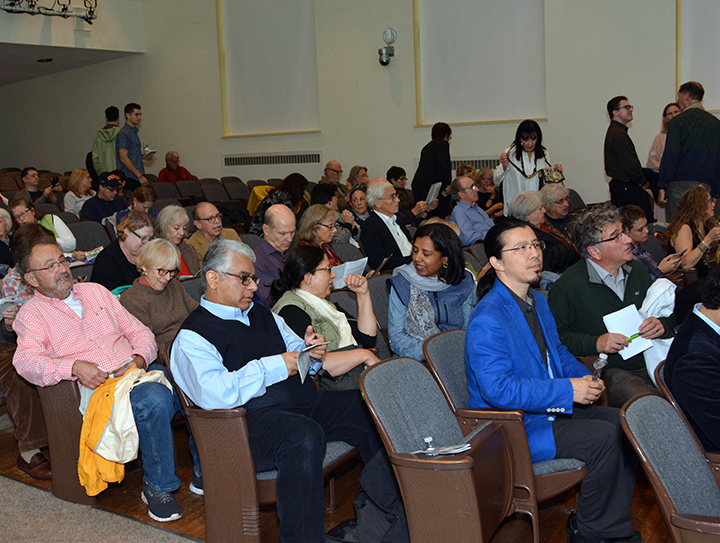
Part of the crowd on hand today for the Town Hall TEA talk. (CLICK TO ENLARGE) Contributed photo
“But at the same time it’s art bringing people together,” he said.
Barker said one of the areas where regional theaters have to make gains is in leadership diversity.
“We haven’t moved,” he said, adding that it remains all white. “We should be opening up our leadership.”
That theme capped the third conversation between former Staples High School Principal John Dodig and his former student Harris Durrani.
Durrani, an author, law student and practicing Muslim, talked about being a minority at Staples.
His novella, “Technologies of the Self,” is based on his growing up the son of a Pakistani father and Dominican mother, being a Muslim and living in Westport.
“It’s a story that arose from my own experiences,” Durrani said.
Dodig asked what books he would recommend to schools to educate students about Muslims. Durrani unabashedly suggested his own.
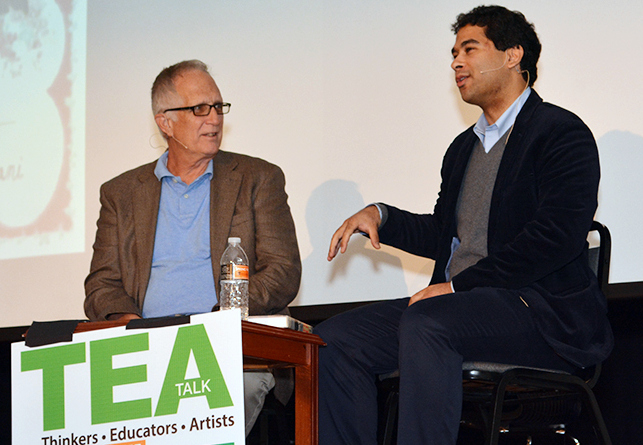
Former Staples High School Principal John Dodig (l) and his former student Harris Durrani. (CLICK TO ENLARGE) Contributed photo
“I never read a story that was true to the experience of Muslims in America,” he said.
When Dodig asked whether Durrani would continue to write fiction even after becoming an attorney, he said yes.
“Storytelling is a direct path to changing people’s minds,” he said.
As the TEA Talk concluded, WAAC Co-chairman Richard Epstein presented Durrani with the WAAC’s Horizon Award.


