

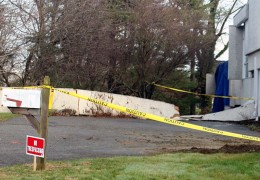
A blue tarp is now on top of the house at 16 Minute Man Hill, and yellow caution tape surrounds the property. (CLICK TO ENLARGE) Jennifer Connic for WestportNow.com
By Jennifer Connic
A blue tarp was placed today on the Paul Rudolph-designed house at 16 Minute Man Hill in Westport.
Stamford Superior Court Judge Taggart D. Adams ordered on Friday that no further demolition be done to the house until court hearings on a temporary injunction could be completed (See WestportNow Dec. 22).
The Connecticut Trust for Historic Preservation, which is seeking the injunction, had asked for coverage on the roof, which had been removed, so the house could be protected from the elements. But the judge did not include it in his order. There were heavy rains Friday night and Monday night.
Since the court hearing, the subject of a tarp had been discussed in numerous e-mail correspondences, said Philip Walker, attorney representing the trust.
“It was our objective to obtain permission to put up a temporary covering to prevent water damage,” he said.
When called late this afternoon, Walker said he did not know the tarp had been placed on the house.
Town Building Official Stephen Smith said he responded to a complaint that the house was being demolished without a permit today, and he found two workers placing a tarp on the house to protect it from the elements.
Developer David Waldman, who has a contract with the owner to buy the house, could not be reached for comment.
“If (the tarp is on the roof), it is good news,” Walker said. “The trust extends its gratitude to whoever did it.”
Observers of the house were again worried about potential for demolition today although a permit has yet to be issued for the house.
Morley Boyd, Historic District Commission chairman, said several people had reported they heard loud banging inside the house and yellow caution tape now surrounded the property.
It is the second time town officials have had their attention drawn to the house because of possible demolition. Last week, town officials came to the site after several people reported demolition work was taking place at the site (See WestportNow Dec. 21).
Smith said the owner has completed all the necessary local requirements for the house to be demolished, and now he and his staff are waiting for the judge’s ruling before issuing the permit.
The Rudolph House has been the attention of many architects and historic preservationists over the last few weeks since it first appeared on WestportNow as a Teardown of the Day (See WestportNow Dec. 13).
The Connecticut Trust for Historical Preservation has asked for an injunction on the demolition under the state Environmental Protection Act because state officials ruled that the house is eligible for the National Register of Historic Places.


Excellent news. I
As much as any layperson can, I admire Paul Rudolph’s work – structure and philosophy – here and outside of the USA; but, that pit in the gut that cultural vandalism leaves behind is just as stomach-churning as encouraging the courts to interfere in private property matters. Isn’t that sort of reach into an individual’s home unattractive?
So in other words, Mr. Grimm is all for property rights unless he doesn’t like what the owner is doing with the property.
Sorry, but that’s not what the founders intended, and it’s not how the constitution works. Mr. Grimm and his like-minded commenters, in all their many posts on this subject, have yet to cite the law that allows them to prevent the owner of this house from exercising his right to do what he wants with it.
Mr. Grimm seems to believe that the owner should be made to subsidise Mr. Grimms’ aesthetic sensibilities because, well… just because. I guess becuase the “preservers” are so confident that they have a superior morality. Mr. Grimm pretty well says as much: He would impose restrictions on a home owner, after the fact, because he disagrees with the homeowner’s choices. Where does this logic stop? And who gets to decide? And how will Mr. Grimm like it when this ricochets on him some day, as it most surely may if given enough time?
This house was on the market for some time, and nobody who wanted to preserve it bought it. (However architecturally “significant” it may be, perhaps the market was telling us that it is not everybody’s aesthetic cup of tea?) Now that the new owner wants to take it down, self-appointed know-betters want to prevent him from doing so, for the sole and simple reason that they don’t like his choice. That is a slippery slope indeed, one down which this town has been sliding for some time.
Westport seems to be evolving toward a very scary theory of property rights, where the neighbours of a property have more rights in a property than do the owners. We saw it when we couldn’t build basketball courts at Bedford Middle School. We saw it when we had to guarantee property values for residents next to Greens Farms School because the school would be used as a school, like it had been for something like 100 years before! We saw it on Sturges Highway, where neighbours ganged up on a builder and threatened to destroy his economics if he didn’t do what they wanted. And we saw it in the ARS property, where a gang of NIMBYs essentially extorted a piece of land from its owner: literally forcing him to give most of his land to them so that they would deign to let him build on what little land they left him.
This is un-American, and it is ultimately dangerous. Property rights trump aesthetic sensibilities, and they should. If the agitated preservationists wanted to save this house, they had the opportunity to buy it. They are free to try to buy it from the current owner. But to otherwise interfere with the owner’s property rights is a bad idea. If I were the owner, I’d be suing the preservationists for tortious interference.
It’s reassuring to see protection being added to the Micheels house – another positive step toward preserving the building for the long term.
While it’s quite possible that the house suffered interior and/or structural damage due to premature demolition efforts it seems very unlikely that it is beyond repair. There are numerous examples of buildings rescued from the direst of physical (and political) conditions only to be skillfully restored later. The Villa Savoye, for example, (built by the Swiss architect Le Corbusier and mentioned in reference to Paul Rudolph earlier on this site), fell into ruin after World War II, was saved from demolition by public advocacy, and was impeccably restored. This building is now one of the most studied and photographed Modern houses in the world.
Given the strong public support emerging around the Rudolph house recently we can remain hopeful that it will be given similar chance for survival in the upcoming hearing. This hearing may be focused on the
Micheels house in particular but it carries greater significance in the debate between short-term real estate prospects and long-term architectural value. In this way it will set an important precedent for other buildings that have either not yet been protected from demolition
or do not neatly fit the criteria for historic designation. Within this debate it is not as important whether we personally “like” or “dislike” this building, or even, in my opinion, how old it is – rather it should be assessed for the significance it holds culturally and within our local architectural history. Critics have already commented
here and elsewhere that the Micheels house holds unique architectural importance and that, in the words of Yale Dean Robert Stern, “the town of Westport will be diminished by this loss.” So let’s hope long-term
value will be rewarded on January 2nd and that it inspires fresh ideas and attitudes about our local architecture culture.
Finally, I’ll just add that as a professor of architecture (at the University of Michigan) I encourage students to visit buildings at every chance they get as an irreplaceable part of their education. If we don’t find a way to collectively value innovative moments of architectural design the prospects for continued experimentation, in
school and in practice, become limited. And the American residential landscape will grow increasingly homogenized.