

By Dave Matlow
Veteran sportswriter Jack Cavanaugh described for Westport Sunrise Rotary Club members today the colorful days of the 1920s when boxers Gene Tunney and Jack Dempsey transfixed the nation.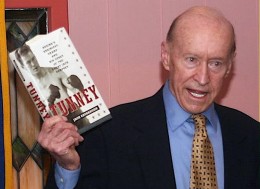
Veteran sportswriter Jack Cavanaugh addressed the Westport Sunrise Rotary Club today about his biography of fighter Gene Tunney. (CLICK TO ENLARGE) Dave Matlow for WestportNow.com
“He was the greatest Irish athlete who ever lived,” the former New York Times journalist and longtime Wilton resident said of Tunney.
“Tunney,” Cavanaugh’s Pulitzer Prize-nominated biography of the legendary athlete, was published by Random House in November and has won widespread positive reviews.
The author reviewed Tunney’s stunning boxing career in which he notched a 77-1 record as a prizefighter, including 48 knockouts. His only loss was a 15-round decision in 1922 to a fearless and unorthodox fighter named Harry Greb.
Tunney won the heavyweight title from Dempsey in 1926 when Dempsey was the most popular athlete on the planet and widely considered unbeatable.
Cavanaugh described their legendary 1927 “long count” rematch in which Tunney defeated Dempsey before almost 145,000 persons at Chicago’s Soldiers Field. The bout made Tunney the first athlete to earn a $1 million purse.
Cavanaugh said Tunney was “the most intellectual of all fighters” who was well versed in literature, once lectured at Yale, and befriended Thornton Wilder and others in the literary world.
Asked who the all-time best heavyweights were, Cavanaugh stated unequivocally: Joe Louis, Jack Johnson and Mohammed Ali.
When asked who he thought was the best all-time boxer in any weight class, Cavanaugh again unhesitatingly stated Sugar Ray Robinson, the welterweight champion in the 1940s and then the middleweight champion in the 1950s.
Cavanaugh noted that after Tunney retired from the ring in 1931, he discouraged discussion of his boxing career.
Tunney died in 1978 at the age of 81 and is buried at Long Ridge Union Cemetery in Stamford.
Cavanaugh said his gravestone refers only to his duty as a Marine in WWI and as a Marine captain in WWII.


