

A Stamford Superior Court judge made no decision today on the future of the Paul Rudolph-designed home at Westport’s 16 Minute Man Hill and testimony by the seller of the property, Louis Micheels, was set for Wednesday.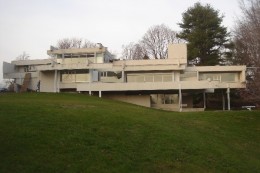
A judge has yet to decide the fate of the home at 16 Minute Man Hill, and court hearings continue Wednesday. (CLICK TO ENLARGE) WN file photo
The Connecticut Trust for Historic Preservation is seeking an injunction on the demolition of the house, which Rudolph designed for Micheels, while the research for placing the home on the National Register of Historic Places can be completed.
Marc Kurzman, attorney for David Waldman, a prominent downtown Westport developer who has a contract with Micheels to purchase the property, told Judge Taggert D. Adams today that Micheels is traveling to Connecticut from his Massachusetts home to testify in the case on Wednesday. The sale has not closed yet.
Additionally, several people stated in testimony today that Micheels opposes the movement to list the house on the National Register of Historic Places.
Helen Higgins, Connecticut Trust for Historic Preservation executive director, said during afternoon testimony that she did not know of Micheels’ opposition until this morning.
The court had met in morning session during which Kurzman unsuccessfully tried to challenge the court’s jurisdiction in the matter.
Paul Loether, deputy state historic preservation officer, said the owner of a property can object to a house being included on the National Register, but the time for that is not until after the nomination process is completed.
If an owner objects, he said, the house is listed as eligible for the National Register and is not included on the actual National Register of Historic Places.
Philip Walker, attorney for the Connecticut Trust for Historic Preservation, presented the trust’s case today.
Included was Gregory Farmer, a historian from the trust, testifying about a National Register of Historic Places nomination form he completed and submitted to state officials on Dec. 31.
But Kurzman questioned Farmer about an affidavit he signed before taking photographs of the property.
Kurzman presented the document that stated Waldman would allow Farmer to take photographs of the property if he did not interfere with the plans to demolish the house.
Farmer said he visited the house on Dec. 15 after contacting Waldman and took about 100 photographs. It wasn’t until Dec. 28 that he began researching for the nomination form, which included information from his visit to the property, he said.
The house meets several of the criteria for the National Register, Farmer said. He cited the fact it was designed by Rudolph, that it is the only residential building he designed in Connecticut, and that it is different than other homes he designed.
He also cited the connection to Micheels, who was imprisoned in the Nazi concentration camps, liberated and came to the United States.
Farmer said he signed the release because he had no reason to interfere nor was the purpose of his visit to the property for the nomination form.
Higgins said the trust did not initiate the nomination process and does not have plans at this time to purchase the house.
Loether said he received a phone call from Bruce Becker, who works for a firm that works on restoring historic structures, on Dec. 18 asking to review the property for study to be included on the National Register.
“I indicated to him that I could not wave a wand and approve it,” he said. “I needed documentation, and it came from several sources.”
Becker, architect Michael Glynn and the Rudolph Foundation provided information, he said, and after reviewing the information his staff determined a study for inclusion on the National Register should be completed.
A letter was sent to Micheels about the process on Dec. 20, which was one day before the Connecticut Trust for Historic Preservation filed the paperwork for the injunction, he said.
Consultants regularly complete the research for the nomination, Loether said, but the state staff does not rubber stamp the report and will review it.
It does not take several years for the process to be completed, he said, but he could not say when the nomination process would be completed.
Loether said his staff is required to file a nomination form once the process starts.
If a nomination form is not filed, he said, any member of the public can file an appeal, and that process can lead to the loss of federal funding.
Adams ordered on Dec. 22 that no further demolition be done to the house until court hearings on a temporary injunction could be completed (See WestportNow Dec. 22).
The Rudolph House has been the attention of many architects and historic preservationists over the last few weeks since it first appeared on WestportNow as a Teardown of the Day on Nov. 16 (See WestportNow Dec. 13).


