

By James Lomuscio
While the rest of the town was digging out today, Westport’s Board of Education was digging into Schools Superintendent Colleen Palmer’s proposed operating budget for next year — $119,170,202.
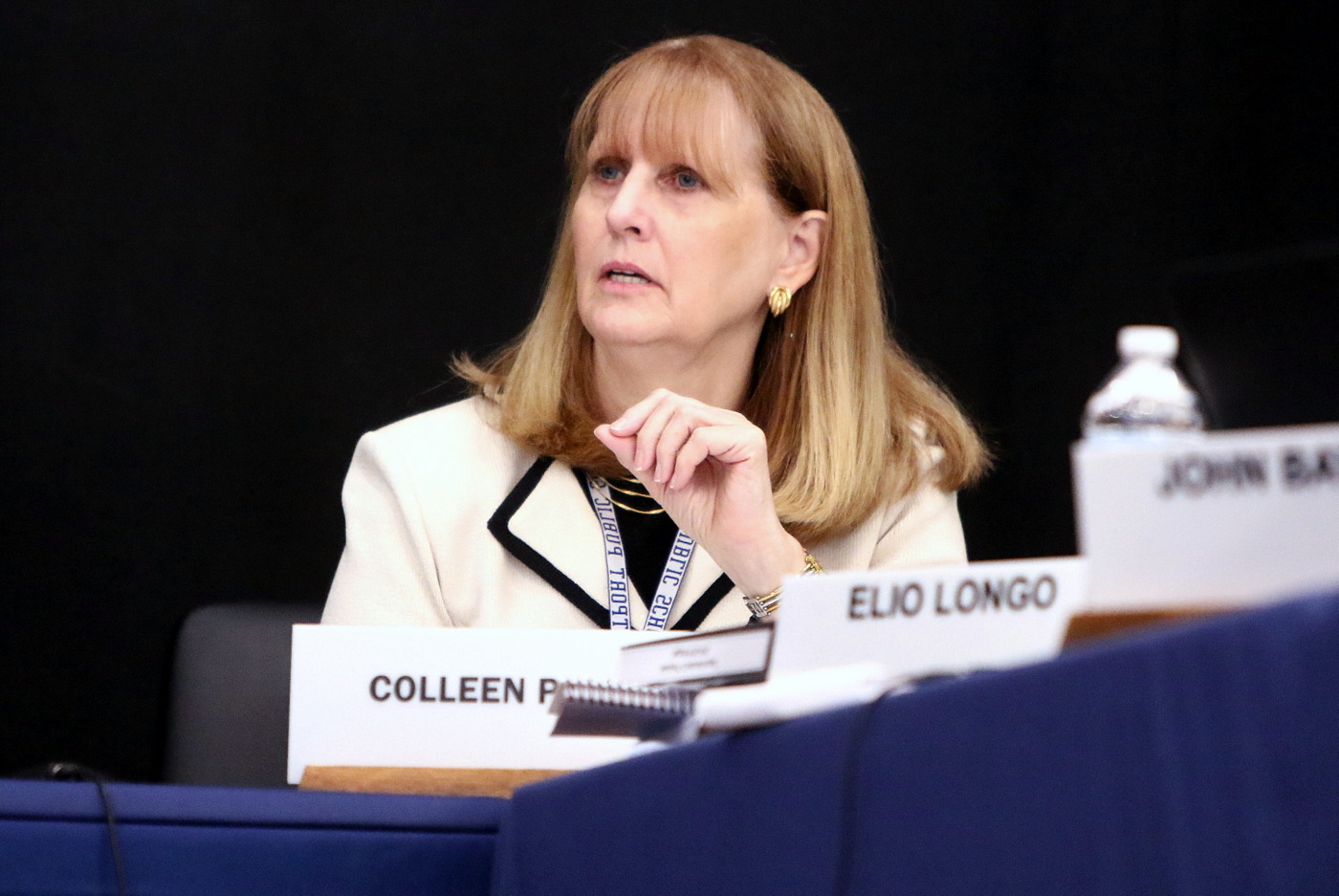
Colleen Palmer at today’s meeting: “I’m prepared to change the way we do business.” (CLICK TO ENLARGE) Dave Matlow for WestportNow.com
In front of a sparse crowd of only 13 persons in the Town Hall auditorium, school board members and several administrators pored over Palmer’s proposed 2018-19 operating budget, a $4,792,855, or 4.19 percent increase, over the current year.
From early morning to 4 p.m., board members and administrators were scheduled to examine the 198-page budget book, looking for areas to trim without compromising the quality of education.
Before and during the meeting Palmer attributed the increase, a significant departure from an average of 2.5 percent jumps over the five several years, to increased medical claims that “are trending unfavorably for the district,” Palmer said.
“The current FY 2018 operating budget was able to be set below 2 percent with the infusion of one-time funds from a robust health insurance reserve last year,” she had said in a formal statement.
“However, now that the medical claims are trending unfavorably for the district, the impact of two years of increases in medical costs are hitting our budget for FY 2019,” Palmer added.
According to the superintendent, salaries and benefits represent 81.5 percent of the total budget and 99.2 percent of the $4.8 million request for new funds.
“We’re in a transitional period with our strategic plan,” Palmer told the board. “I’m prepared to change the way we do business, and I look forward to sharing that as we go forward in the budget process.”
In her budget, Palmer said she targeted a number of cost savings and cost avoidance initiatives.
They include: the reduction of two buses to the Coleytown Elementary School and Coleytown Middle School; effective management of building maintenance; competitive bidding; the “reallocation of existing staff to address high priority needs and increased reliance on data for decision making.”
Palmer’s proposed budget also calls for offsetting custodial costs with $200,000 from the cafeteria fund, permissible with the exit this year from the National School Lunch Program and the “strategic deferral of select nonessential building needs,” such as carpet replacement and interior painting.
“I love how surgically you’re looking at all parts of the district,” Michael Gordon, school board chairman, told Palmer. “I also fully trust that you’re fiscally minded and not spending a penny more than is needed.”
Board member Mark Mathias said he appreciated Palmer’s “fresh eyes” approach.
“As we see these things we ask, ‘When can we get to it?’” he said.
Jack Klinge, a Representative Town Meeting (RTM) member who has served on the legislative body’s education committee for 20 years, said he was pleased with the budget book because it prioritized the need for a three-year budget plan. He said he has been asking for longer range planning for years.
“It’s good business planning,” said Klinge, who was in the audience.
“I think it’s a good budget from the standpoint of operating the schools,” he said. “But, it’s a challenging budget when you have to deal with the health budget.”


