

By James Lomuscio
Neighbors opposed to a developer’s renewed attempt to build multi-family housing in Westport’s Saugatuck area met tonight at the Westport Library to figure out how to stop it.
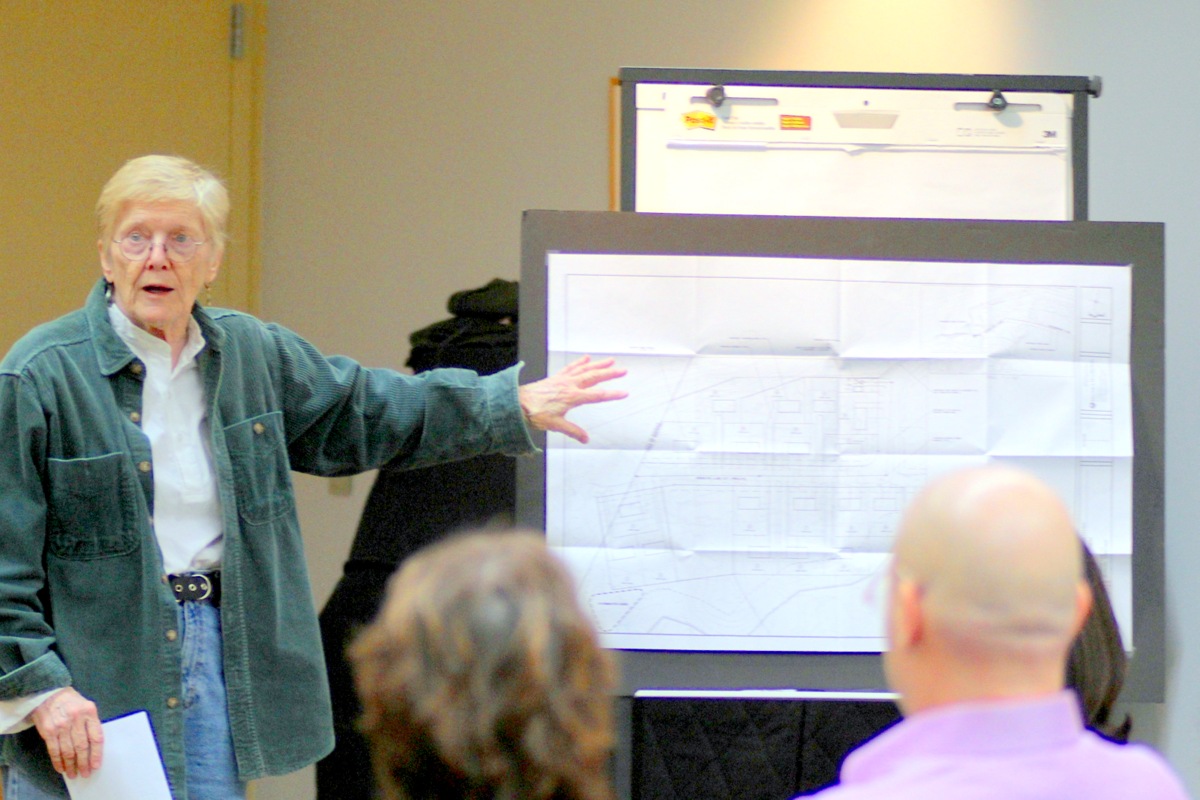
Carolanne Curry addresses tonight’s meeting of Save Old Saugatuck. (CLICK TO ENLARGE) Dave Matlow for WestportNow.com
The meeting by a group calling itself Save Old Saugatuck had a distinct irony—the planned development is to take place on Hiawatha Lane Extension, a community that has long exemplified the town’s diverse housing stock.
About 18 persons showed up for the session in the McManus Room. Their goal was to develop a strategy to oppose plans by developer Felix T. Charney to construct a 186-unit, rental housing complex there. Thirty percent of the units are to be classified as affordable.
The residents say the plan, which uses the controversial state statute 8-30g to override local zoning regulations, puts their neighborhood in jeopardy, all in the name of diverse housing.
The statute allows developers to invoke 8-30g if a town does not have 10 percent of its housing stock classified as affordable, which Westport does not.
Saugatuck is not the only area of town facing the threat of 8-30g. The owner of The Westport Inn, Sheldon Stein, plans to demolish it and using 8-30g, put up five-story structures totaling 200 rental units, 30 percent of them affordable as required by the statute.
Charney, a 1972 Staples High School graduate and Fairfield resident who served as a Westport Planning and Zoning (P&Z) commissioner from 1983 to 1985, is scheduled to present his proposal to the P&Z on Jan. 8.
At that time, his Summit Saugatuck LLC will request the installation of a public water sewer connection from Hiawatha Lane Extension to Davenport Avenue.
.JPG)
Gloria Gouviea, land use consultant, offered tips on how to fight a developer threatening 8-30g. (CLICK TO ENLARGE) James Lomuscio for WestportNow.com
“He’s trying to wear this old Saugatuck neighborhood down, but he does not know who he’s dealing with,” said Gloria Gouveia, a land use consultant who served as the town’s zoning enforcement officer more than 30 years ago.
“We need to let him know right away, he’s in for the fight of his life.”
Gouveia spoke along with resident Carolanne Curry, who resigned as a P&Z alternate to organize the neighborhood opposition. She first founded Save Old Saugatuck in 2004 to oppose an earlier Charney attempt to build multi-family housing in the area.
They and others said it was it disheartening that the Saugatuck area, currently undergoing a renaissance, has historically taken it on the chin.
In the 19th century, Saugatuck homes were lost to railroad construction and eminent domain. In the 1950s, all in the name of the public good again, the Connecticut Turnpike cut a huge swath through the mostly Italian-American community, Gouveia noted.
Now in the name of public good—and housing equity since cities have traditionally born the brunt of multi-family housing units—Saugatuck residents see their community again under siege.
“It’s a special place, and I believe the courts have to pay attention to that,” Gouveia said. “We’re not talking about any old neighborhood.”
“It’s heritage district,” said Curry, who lives at 29 Hiawatha Lane Extension.
But, Curry noted, since 2002, Charney has bought at least five houses in the area that he plans to develop.

Felix T. Charney: developer is 1972 Staples grad and former P&Z commissioner. File photo
“This proposed development will affect all eight streets in our neighborhood, with greatly increased traffic generated in and out of Ferry Lane West from these proposed 186 units of housing,” Curry said. “Many other critical concerns arise from this proposal.”
In addition to traffic, residents expressed environmental concerns, noting that the area has sensitive wetlands. Resident Ken Sosnoski , for one, questioned how such a project could be forced on a private road.
“I live on that road, it’s a private road, and I’ve never heard of forcing such construction on a private road,” he said.
State Rep. Gail Lavielle, who choreographed the history of 8-30g and the uphill battles towns face as the 1989 statute created a “cities vs. towns” environment, said she was not sure if such private roads would have immunity.
She pointed out that that the new Western Connecticut Council of Governments (WCCOG), which starts up in January, replacing the Southwestern Regional Planning Agency, incorporates 18 municipalities, and that 8-30g is on its agenda for the new year.
“Norwalk, Danbury and Stamford are in our COG, and they all feel differently than we do about 8-30g,” Lavielle said.
The best solution would be for representatives of towns and cities in the COG to have discussions on the issue to find answers that work for both, she said.
Lavielle noted that many bills introduced in Hartford to modify 8-30g have been unsuccessful since legislators from cities control the Housing Committee.
“It’s a very hard battle to fight,” she said.
Gouveia said the big problem towns face with 8-30g is that “you have to forget everything you know about local zoning regulations,” since they are superseded by state statute.
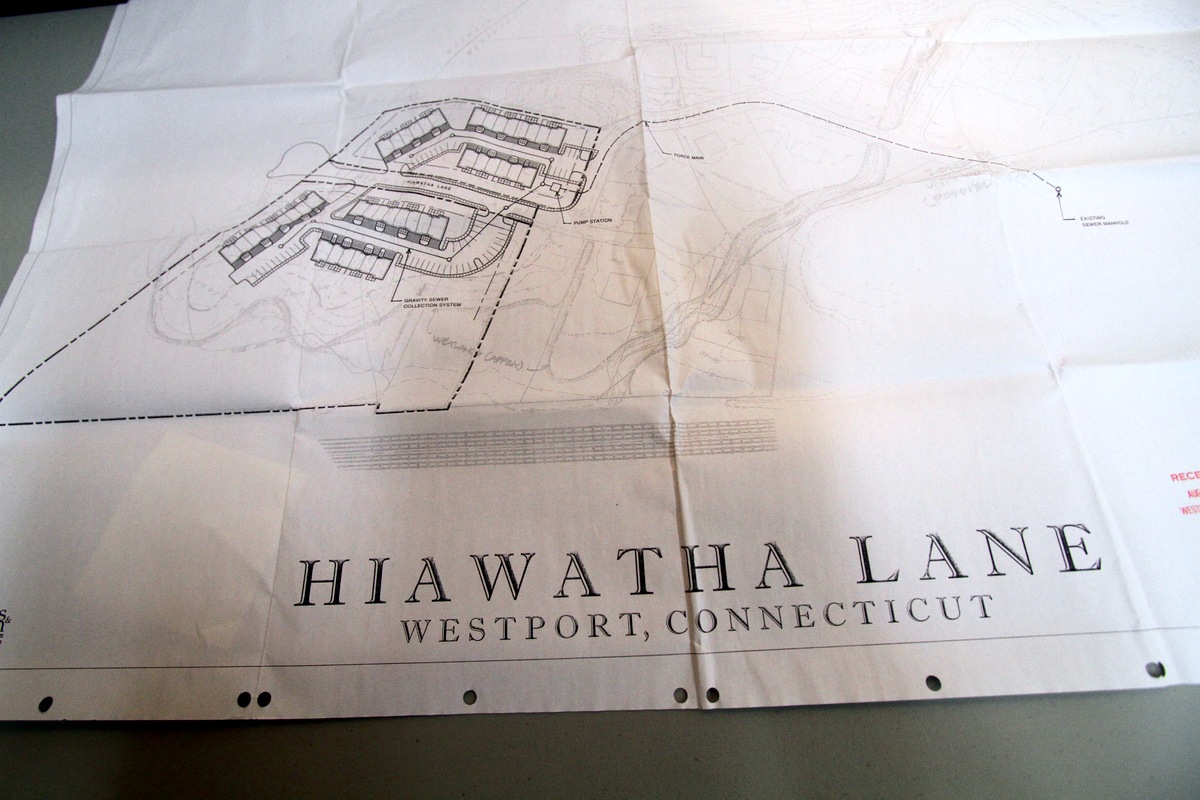
A map showing the proposed development was presented at tonight’s meeting. (CLICK TO ENLARGE) Dave Matlow for WestportNow.com
“This is not an application that’s going to be influenced by public opinion,” she said. “It’s going to be influenced by facts.”
The fact residents should focus on is Charney’s request for a sewer extension, Gouveia said.
“The best we can do is to scare him away with focused opposition just on the issue of the sewer extension,” she said, adding that it is “not an issue that can be solved with deep pockets.”
“It’s important for us to focus on this one application,” she said. “Time is crucial. Equally important is for you to be focused and professional.”
The last time Charney brought forth plans to develop the Saugatuck area was in 2005.
In that attempt, his team said they were not invoking 8-30g and instead presented plans to build 111 multi-family units and eight single-family lots to serve as a transition between the neighborhood and the cluster housing.
They said at least 20 percent of the new units would be affordable.
And they said if town officials did not like the density or the plans, the group would go away and not consider it any further. (See WestportNow Nov. 17, 2005)
The plan, however, hinged on Summit Development purchasing about 14 single-family homes in the neighborhood. It eventually purchased at least five homes at prices significantly above market rate but dropped the plan in face of neighborhood opposition.
Neighborhood concern about Charney’s plans go back to 1999 when his group first got involved in developing the neighboring Norden property in Norwalk.
Initial plans called for an access to the site through the Saugatuck area now involved in opposing his latest plan.


What is being presented or requested on Jan 8 is to extend the sewer line to the property in question. The proposal for the housing itself is not actually on the table, but is of course the underlying reason for the request.
The P&Z is the first stop in these matters and they decide under statute 8-24 on all matter regarding town owned infrastructure.
The P&Z heard this request many years ago and voted no to the extension. They are asking again.