

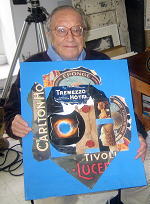
Artist at work: Alan Fontaine holds one of his many collages that wil lbe on display at Barnes & Noble Booksellers next month. (CLICK TO ENLARGE) James Lomuscio for WestportNow.com By James Lomuscio
At 88, veteran shutterbug Alan Fontaine has yet to give up on his muse. His quest for the artistic in the most unlikely of places still consumes him, whether it’s through the lens of his camera or his mind’s eye.
The longtime Westporter finds beauty in old torn posters, random rocks in Central Park, the innards of computer hard drives, flattened soda cans he finds along Westport’s Main Street, cracked and mildewed old furniture, even car parts he ferrets out of junkyards.
“The rustier the better,” says Fontaine with the conviction of one who spies a creative treasure trove in detritus.
“I’ve been collecting things all my life, and I’ve always been interested in things that have age,” he said.
“I look for things that are old,” Fontaine quipped, “like me.”
On a recent afternoon. he and his son John were busy deciding what works they would include in an upcoming show of Fontaine’s collages scheduled for the entire month of July at Westport’s Barnes and Noble Booksellers. This will be Fontaine’s third show there; the last one this past January was a 60-year retrospective of his photography.
Fontaine opened his first commercial studio “on April Fools’ Day” 1946 in a carriage house on New York’s East 40th Street. And while he always heeded a creative call from some other realm, Fontaine had sufficient real world tether to keep him grounded long enough to build a roster of corporate and celebrity clients.
Over the years he photographed boxer Jack Dempsey and a cavalcade of starlets and models. One was an obscure model who would later be known as Martha Stewart.
Assignments took him to Rome, Florence, Venice, even the White House where he photographed President Kennedy’s scrimshaw collection. He admits that while on that assignment his penchant for touching and examining everything he saw in the Oval Office exasperated the Secret Service. His larger than life efforts were perhaps best seen by the huge Kodak Colorama photos displayed at Grand Central Station during the 1960s.
His biggest challenge came 12 years ago when a heavy fall rain overflowed a stream that poured into his Westport basement studio and nearly destroyed his life’s work. After the water was pumped out, Fontaine returned and tried to salvage what he could.
“I was too depressed, but I figured I would try to make prints out of some of the negatives,” he said.
The dampness had caused mold to grow on the negatives, and when he printed them he found that mold had transformed the chromes into something surreal. Ever true to the creative process, Fontaine discovered a new art form he dubbed “moldage.”
Soon he and his partner Edie Van Breems had negatives placed in petri dishes, growing mold on them and using the chromes as a canvass for anyone who wanted to see themselves moldaged.
The late actor Jason Robards was one of the celebrities to be moldaged, and Fontaine’s new art form had gallery showings in New York City, as well as its own website.
From moldage Fontaine moved into another area, anamorphic photography. He would shoot objects as they were reflected on a mirrored tube, “so that it gives them 180 degrees of distortion.” His anamorphic photos of classic paintings, including the Mona Lisa and Velasquez’s “Pope Innocent IX”, where displayed in 1989 in five of Tiffany’s windows.
Later he returned to his first love, making and photographing collages.
“A lot of it has to do with combining objects and getting an interaction between them,” he said. “It’s a surrealistic view to have an object that is not connected or in context with the background.”
“My philosophy is that even if it is very disparate and not connoted it does not bother me,” Fontaine said. “The important thing is the texture and the design.
“It’s not necessarily symbolic,” he added. “It’s a simply free expression with no literal meaning. If they work visually, that’s okay for me.”
Thus explains the crushed Coke cans, computer bits and pieces, insulator caps, torn billboards, mannequin hands, Baroque scrolls and hubcaps. Fontaine finds beauty where they meet.


Alan’s moldage photos are wonderful—if you ever get the chance to see them, take it. You can see more of his work on his website, which is located here: http://www.alanfontaine.com/index.html.