

By James Lomuscio
In the wake of national concerns about the militarization of police departments, an issue brought to the forefront by the police response to rioting in Ferguson, Mo., Westport Police Chief Dale Call weighed in on his department’s receipt of military surplus over the years.

One of two Humvees Westport Police received as military surplus. (CLICK TO ENLARGE) Dave Matlow for WestportNow.com
“Define militarized,” Call said in an interview. “Police departments have been organized in the paramilitary structure since the beginning of time, but at the end of the day, we’re don’t function as the military, nor should we ever.”
With Westport being an affluent community and not being strapped for equipment, “we don’t ask for what we don’t need,” from the Department of Defense (DOD) through its 1033 program, Call said. The program gives without charge military resources no longer used, from guns to Humvees.
The Washington Post reported last week that in 2013 the 1033 program gave about $500 million worth of equipment to local departments, mostly for natural disaster responses, items such as tents, generators, ATVs and pickup trucks. However, law enforcement agencies can also tap the program for more formidable items: aircraft, grenade launchers and tactical vehicles.
Speaking in response to the Ferguson riots caused by the shooting of an unarmed black man, President Obama said Monday that the 1033 program must “make sure that what they are purchasing is stuff they actually need.”
“Because there’s a big difference between our military and local law enforcement, and we don’t want those lines blurred,” Obama said. “That would be contrary to our traditions.”
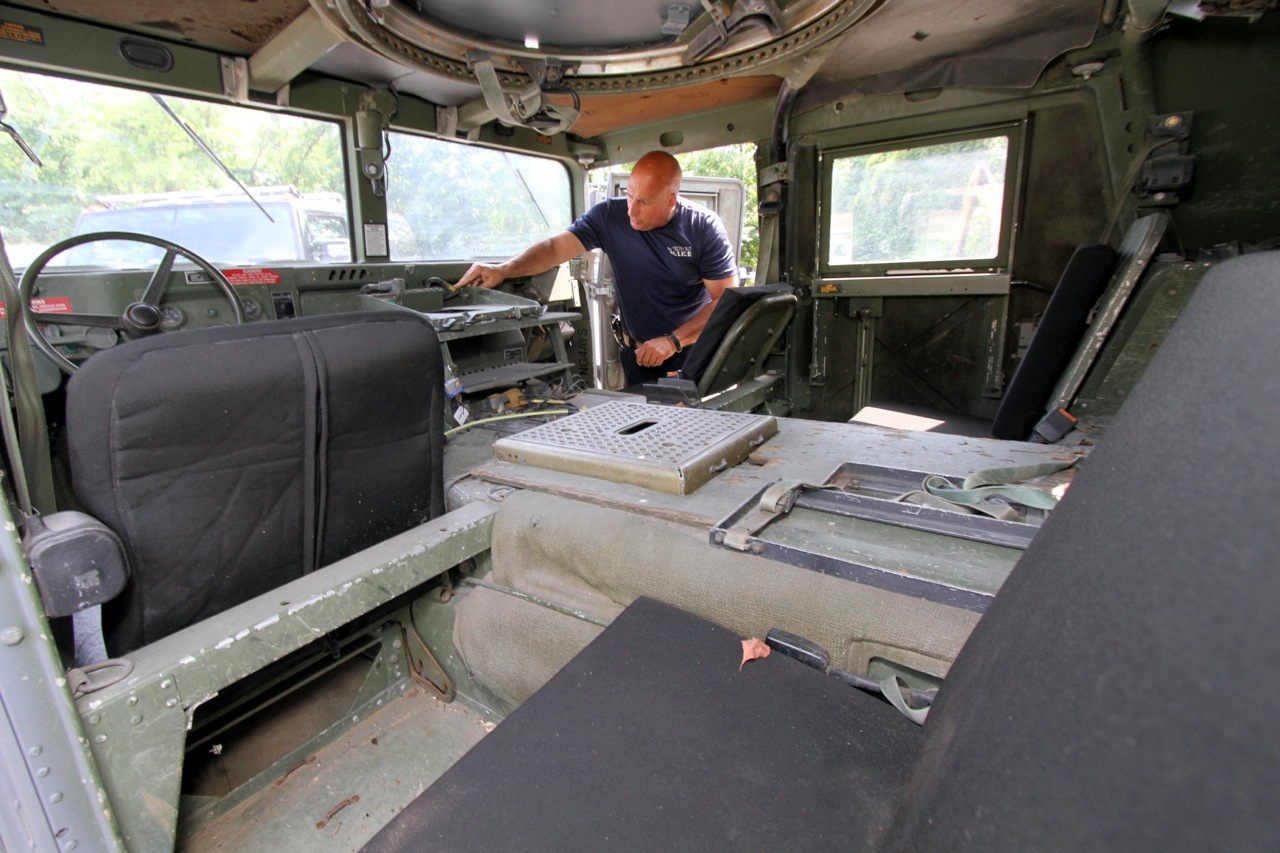
Westport Police Officer Pete Biagiotti shows off the interior of one of the Humvees acquired by the Westport Police Department. (CLICK TO ENLARGE) Dave Matlow for WestportNow.com
In Westport, Call agreed, stressing that those lines should not be blurred since police departments operate under different, stringent rules, “and we’re here to serve the community.”
He said that the two Humvees his department got from the DOD in the past six months, plus a third parts vehicle from the government via the Stamford Police Department, were specifically acquired for search and rescue—and in keeping with the police “serve and protect” code.
“These are for high water rescue and storm operations, and we realized we needed them after Sandy,” Call said, noting that during Super Storm Sandy in 2012 “it took us two hours to respond to a burglary in Saugatuck Shores.”
“Getting these was part of a three- to four-year process of finding one that ran,” Call said.
Also, a Humvee, he said, is shared with Fairfield “if they need it for evacuation from low lying areas.”
The Westport Fire Department has a 2.5-ton, surplus U.S. Army truck that it uses for high water and snow rescue, Fire Chief Andrew Kingsbury said.
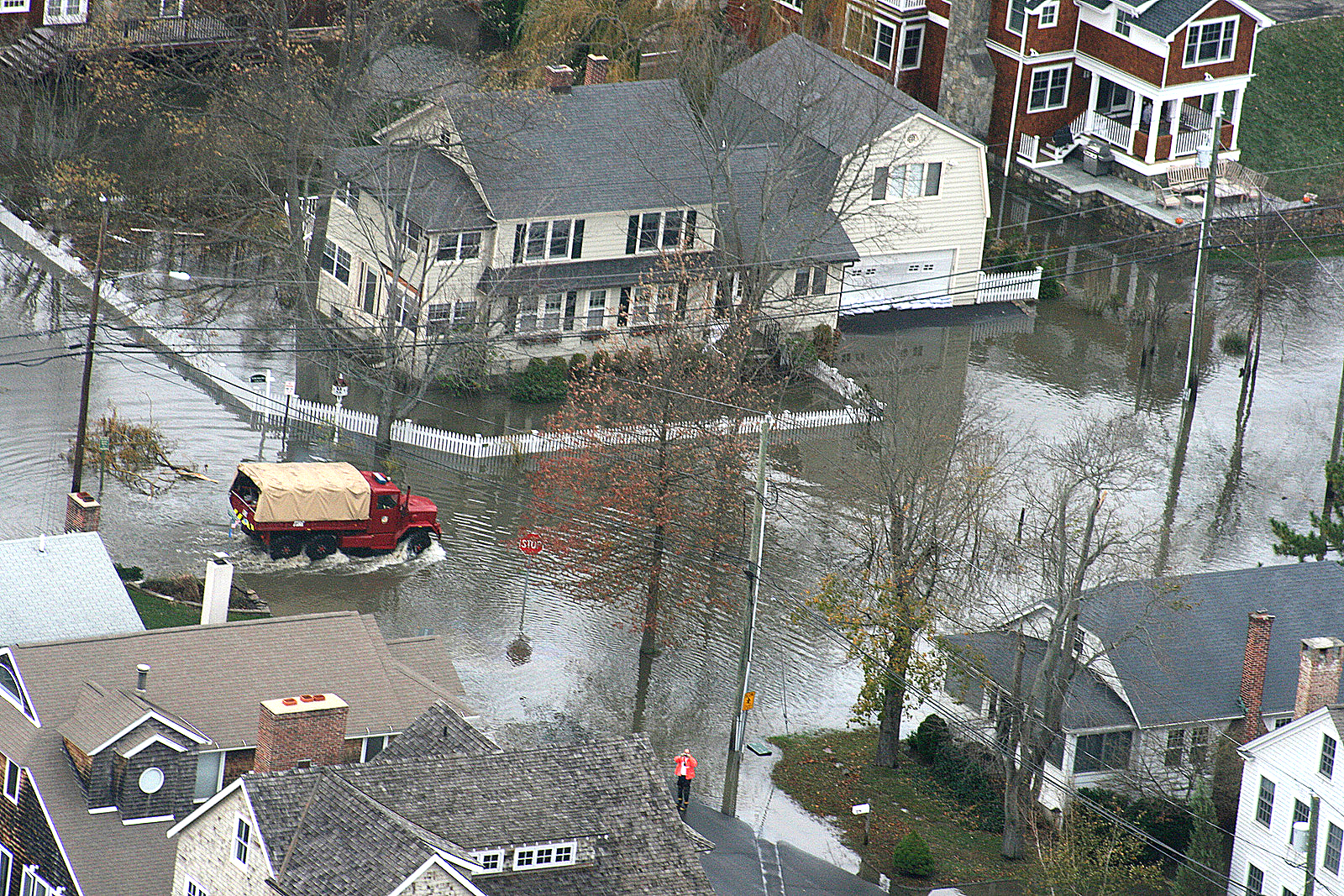
The Westport Fire Department’s high water rescue truck in action in the Compo Beach area during Storm Sandy in October 2012. (CLICK TO ENLARGE) Connecticut National Guard photo
However, he noted that the truck did not come from the 1033 program but from the state Department of Energy and Environmental Protections forestry program.
“We use that during high water rescue and during blizzards,” Kingsbury said.
“We actually got a resident out of her house in three feet of snow, and we even towed an ambulance with it.”
The 1033 program began in 1997, at which time the Westport Police Department received six M-16 rifles “because we didn’t have any rifles at the time,” Call said.
“They’re obsolete, we don’t do anything with them, and we’ve offered to give them back to the government, but they won’t take them,” he said. “We’ve only trained on them on a couple of occasions.”
Through the program, the department also received 12 M-14 rifles “solely for our Honor Guard,” he said, noting that they are only used to shoot blanks during Memorial Day and Veterans Day ceremonies.
Over the years, the department also received a supply of blankets and shovels from the DOD, “but the blankets got all moldy, and we got rid of them.”
“That’s the extent of the military equipment we have received,” Call said.
Call noted that even prior to the 1033 program, police departments benefited from military surplus. He pointed to a 1959 photo of the Westport police standing in front of a World War II DUKW (colloquially known as Duck) amphibious vehicle that the department used for water rescue.
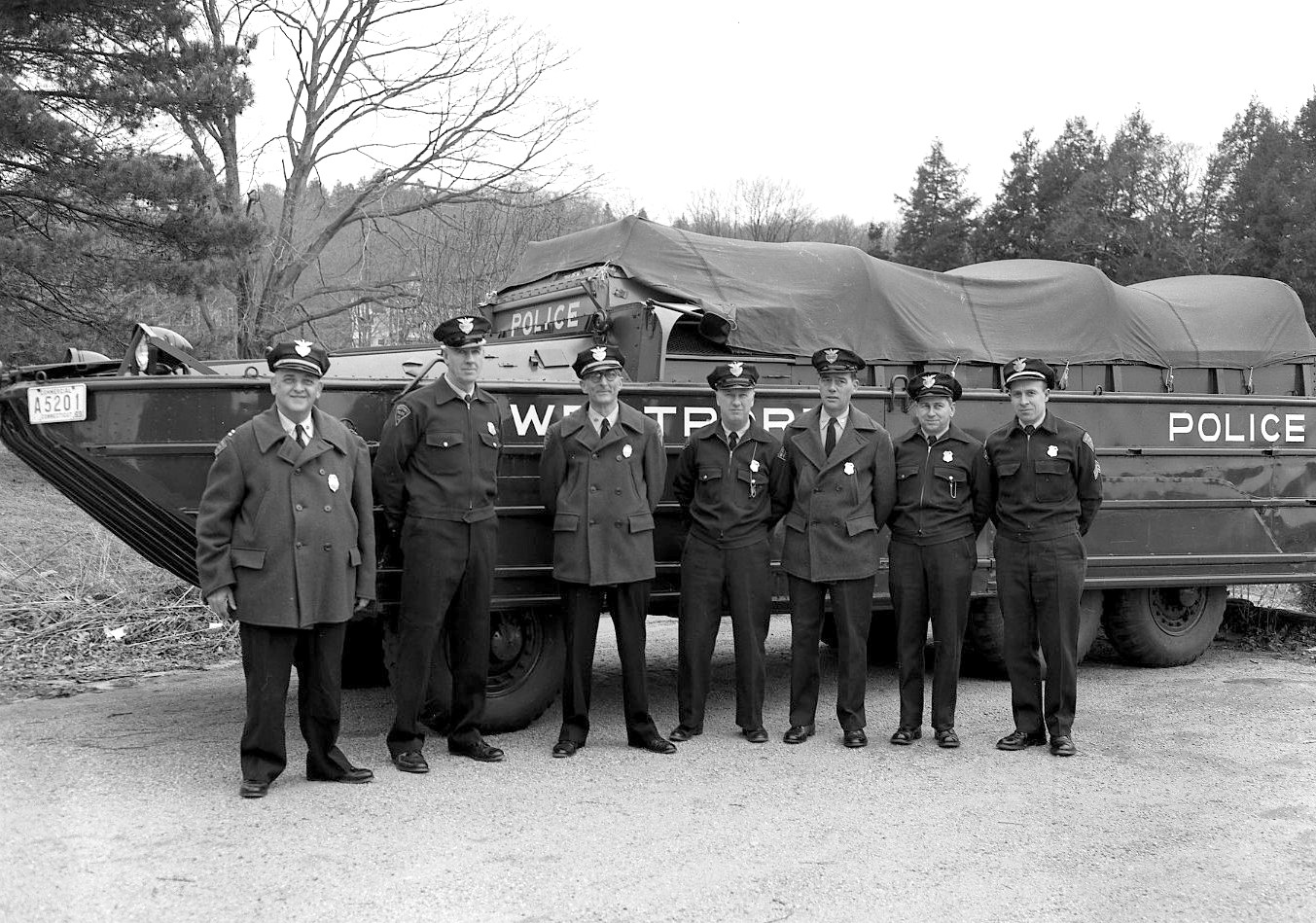
Westport Police acquired a World War II DUKW (colloquially known as Duck) amphibious vehicle in the 1950s for water rescue. (CLICK TO ENLARGE) Westport Police photo
Westport officers also participate in a five-town regional SWAT team that uses a heavily armored BearCat personnel carrier with .50-caliber armor protection and high clearance for rescue.
Yet despite its formidable presence, Call pointed out that the BearCat is not specifically a military vehicle. Manufactured by Lenco Armored Vehicles, the BearCat is designed for law enforcement and private security, as well as military, according to reports.
Regarding growing concern about America’s police becoming militarized, a fear shared by the those on the left and the right, Call stressed that trust in the police “depends on the level of goodwill you’ve built up.”
“Do people trust your police department?” he asked. “In most towns, that’s how it works.
“It takes very little to lose that trust, and we’re cognizant of it all the time, and we know that what happens in one part of the country affects others,” he added.


The last photo of the Duck is a great example of WPD history. It was taken in the 1950’s or 60’s when the men pictured were all members of the Westport Auxiliary Police unit. It was an organized unit of unpaid volunteers who helped in storms and emergencies and also rode patrol with regular officers on weekends.They were un-armed but carried nightsticks and received some basic training. I remember the names of all but one. L-R: Henry Baer who commanded the unit; Russell Greaves, John Dunphy, Ivan Spangenberg, Bruce Allen, Al Montana and my apologies for not recalling the name of the man on the far right. The Auxiliary unit was disbanded when training regulations became too stringent to support volunteer units, but many went on to become certified as Special Police Officers, again volunteering for the extra training at their own expense. They were a vital part of community policing during a time when the department was small. As full time workers, Henry Baer owned the news stand at the corner of Railroad Place. Russ Greaves was the caretaker for the Dorr-Oliver properties off Weston Road. They all had busy careers but gave freely of themselves to heklp the Town. – Dick Alley – Inspector (Retired) WPD.