

By Jarret Liotta
A dramatic drop in student enrollment this year is being called “an anomaly” by a school consultant.
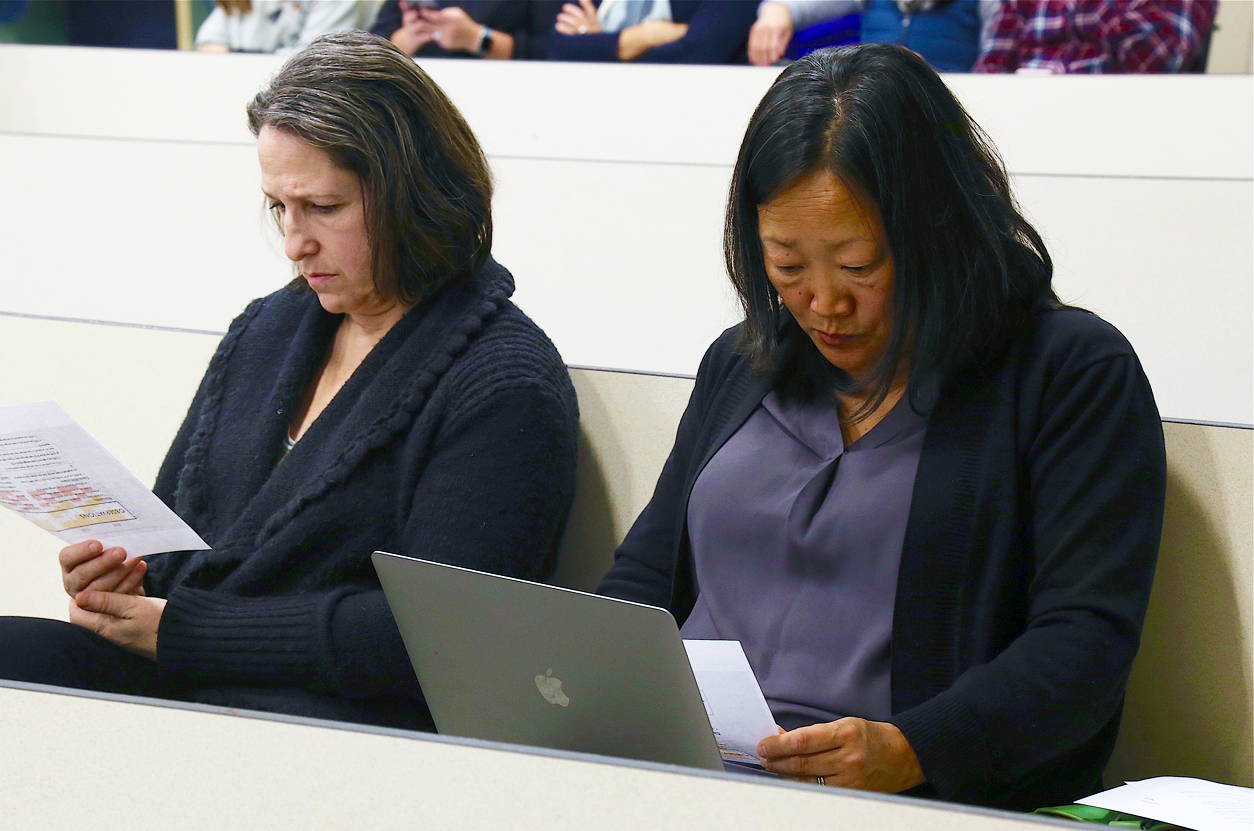
New Board of Education members Lee Goldstein (l) and Youn Su Chao look over enrollment data. (CLICK TO ENLARGE) Jarret Liotta for WestportNow.com
Regardless, Mike Zuba of Milone & MacBroom told the Board of Education (BOE) Monday night that enrollment numbers will still steadily decrease over the next several years, as has been previously predicted.
On the heels of putting Coleytown Middle School (CMS) students at Bedford Middle School (BMS) following the CMS closing last year, 117 fewer students than were expected began the 2019-20 school year. As of Oct. 1 that number was 122.
“That caused a lot of alarm and we wanted to go back and do a deeper dive,” Zuba said, with the 2.3-% deviation mainly hitting grades 3 through 8, as well as reflecting a smaller incoming kindergarten class.
Milone & MacBroom’s medium projections were for 5,369 students in K-12, while the actual is 5,247. Last year’s K-12 enrollment was 5,466, which amounts to a 4% drop.
“This year differs greatly from anything that we’ve seen in Westport over the last decade and a half,” said Zuba — in particular a “negative migration” of students leaving upper elementary and middle school grades.
“We are not putting a lot of weight in it because it is such an anomaly compared to what we’ve seen,” he said.
“One year we don’t jump and say it’s a trend … but it’s certainly something that bears watching,” he said.
BOE member Vik Muktavaram raised the question of how much in that drop was attributable to fears and frustrations related to the CMS crisis, as he said he has heard “anecdotally” throughout town.
“How much of that has to do with housing,” he said, “versus how much of that has to do with parents taking students out to private schools.”
“There’s no way of telling,” Zuba said.
BOE member Elaine Whitney said, however, that the data is potentially available and suggested the administration do some research into those numbers.
“It may only be for a temporary period,” BOE member Neil Phillips said, “and then they’re going to re-engage in 9th grade.”
As the BOE is considering a possible redistricting vote for next month, it asked Zuba to prepare a recommendation on what he feels would be the best elementary school choice if it went with a “split feeder” plan and had students divided between BMS and CMS.
“Ultimately I’m looking for the recommendation of the administration about how we should proceed,” Whitney said.
Outgoing BOE member Neil Phillips said the two new members — Lee Goldstein and Youn Su Chao — should be brought into the discussion, which he hoped wouldn’t be bogged down by an ongoing quest for more and more data.
“You have to make some room for yourself to make a decision and not get stuck in more data,” he said.
Finding a permanent superintendent of schools was also discussed briefly, as a search consultant — Joseph Erardi, Jr. — presented his plans for the search, which will include a range of public and staff meetings to gather input.
According to his timeline, a new superintendent will be appointed the week of March 16.
Through the end of this year a series of focus groups will be held to gather a profile, with advertisements for the position beginning after the new year.
Erardi said six to eight final candidates will be ready for interviews the first week of March, with the two or three remaining finalists given a follow-up interview the following week.
“Every faculty member and staff member will have the opportunity to share,” he said, with meetings scheduled at each of the schools.
“This puts us in a terrific position to name your new superintendent by mid-March,” Erardi said.


