

By James Lomuscio
When it comes to its downtown, Westport does not fit the standard, cookie cutter image of a New England town, to hear Planning and Zoning Director Laurence Bradley tell it.
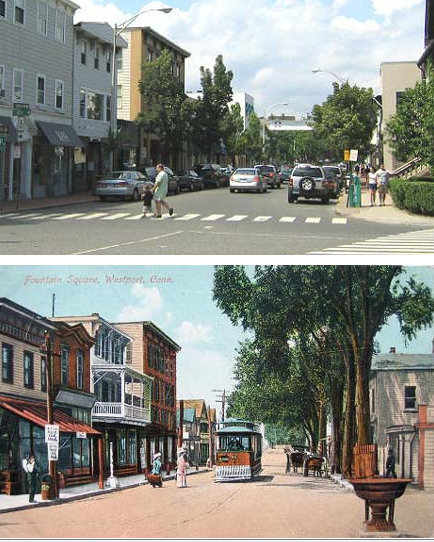
A 2003 view of Westport’s Main Street (top) and the same view (bottom) from a 1913 postcard. (CLICK TO ENLARGE) WestportNow photo/file photo
“Westport looks like Westport,” says Bradley, describing the eclectic downtown that has evolved from a late 18th century shipping nexus on the Saugatuck River behind Main Street to a regional retail hub.
But even though the downtown’s buildings chronicle the Westport’s growth from Colonial to current, Bradley stressed, there is a need for a unifying, “cohesive character.”
That is the thrust behind the Historic District Commission’s (HDC) desire to create a Historic Village District downtown. It is also the subject of a $30,000 state funded study scheduled to be aired at an HDC public hearing at Town Hall, on Monday at 7 p.m.
“Basically, it’s the presentation of an idea that came out of a process we initiated a year ago as a result of concerns about the changing face of Westport with all the new and planned development,” said Henkels, HDC chairman, citing pans for revamping National Hall and the ambitious Bedford Square project on Church Lane.
“It’s going to be a presentation because state law mandates public participation in the process of all the stakeholders,” he added.
The report will be presented by Public Archaeology Laboratory, Inc., the Pawtucket, R.I.-based architectural historian and planning firm that undertook the study funded by the Connecticut Historic Preservation Office.
Henkels said the HDC is also looking for another grant to help the commission draft the regulation to establish the district.
“Ultimately, this will be enacted by the Planning and Zoning Commission,” he said.
According to Henkels, creating a village district is consistent with the 2007 Town Plan of Conservation and Development. He described the village district as “less stringent that a Historic District,” which is created by residents and gives the HDC review responsibilities.
“This village district aims at preserving historic buildings downtown, but it goes beyond that in that it identifies the features of the downtown that gave it its character that we all value, while supporting and guiding future development,” Henkels said.
According to Bradley, creating a Historic Village District is “something the Planning and Zoning Commission had contemplated back in 2007 when they developed the Town Plan.”
“It gives the Planning and Zoning Commission greater ability to review architectural designs of buildings within the district,” he said. “It gives us the ability to look at things beyond setbacks, coverage and use.”
The aim, Bradley stressed, is making sure new buildings are “in context with a certain character of the district..”
“It’s helpful to builders and designers because they go into the process knowing what kind of designs meet the protocols,” Bradley said.
“The idea is to create cohesive character.”


“Viallage District” designation is a wonderful tool for preserving and enhancing the character of Westport. Rather than decry changes to downtown and being at the mercy of developers, I encourage concerned citizens to come out to hear this presentation and get involved in the process of making Westport’s center a place that reflects our history and character.