

The judge presiding over a hearing involving a legal effort by preservationists to delay demolition of a house at Westport’s 16 Minute Man Hall designed by modernist architect Paul Rudolph today cited procedural problems with the case and also encouraged the two parties to discuss the potential for dismantling the house.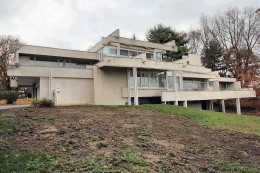
A lawyer for the contract owner of the house at 16 Minute Man Hill testified today his client would be willing to see if it could be dismantled and moved. (CLICK TO ENLARGE) WestportNow.com file photo by Dave Matlow
David Waldman, the contracted owner for the house, also said during testimony before Stamford Superior Court Judge Taggert D. Adams that his family stands to lose $500,000 if he cannot close on the house later this month because of an injunction.
It was the third day of hearings on the case brought by the Connecticut Trust for Historic Preservation to prevent Waldman from demolishing the house until a nomination process to the National Register for Historic Places could be completed.
On Tuesday, the trust’s attorney presented his case and today Waldman’s attorney presented his case through testimony from Waldman, Realtor Sandy Ruta and Louis Micheels, who is selling the property to Waldman.
During testimony today, Waldman said he had inquired of several ways of demolishing the house, including having someone dismantle and remove the structure if it can be done in a cost-effective and timely manner.
“I am interesting in pursuing that,” he said.
Several people have approached him about dismantling the house, Waldman said, but they have said it may be difficult because the house is on a narrow, private road.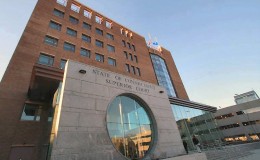
Stamford Superior Court was the site of the third day of hearings today on the fate of the house at Westport’s 16 Minute Man Hill. (CLICK TO ENLARGE) Dave Matlow for WestportNow.com
He also offered the drawings of the house to others so it could be replicated in another location, he said.
Adams asked if the matter of dismantling and removing the house had been discussed between the two parties after Waldman made the comments during testimony.
Stephen Conover, one of Waldman’s attorneys, said it has not been discussed and his client was willing to have the discussion.
Adams suggested the two parties discuss the matter further, but no conclusion to those discussions was presented in court today.
Adams also said later there are a number of legal and proceedural problems with the case, including the fact that Micheels, who technically still owns the property, was not served the court papers.
“I’m not sure I can serve him an injunction if I go that way,” he said. “Things need to be done in an appropriate manner.”
Additionally, he said, Waldman’s wife, who signed the sale contracts, is not listed on the court documents.
Also, he said, there is the question if the Connecticut Trust for Historic Preservation should present a bond for the house, which would be a substantial amount of money towards the more than $3 million sale price for the house.
“Is a bond required?” he said. “If so, then we are dancing around something you cannot meet.”
Waldman said he was not aware Paul Rudolph had designed the home or its significance until comments were posted on WestportNow when the house was listed as a Teardown of the Day on Nov. 16 (See WestportNow Nov. 16, 2006).
He checked the zoning and other regulations to see if there were any measures in place to prevent the home’s demolition, he said, and there were none.
In October, Waldman said, his wife signed a contract to purchase the property for $3.2 million and presented Micheels with a deposit of $324,000, and the contract was contingent on securing a demolition permit.
Because demolition work such as removing the roof needed to be done in order to secure a permit, he said, the contingency of the contract was removed in November and the Waldmans increased the deposit to a total of $500,000, which the Micheels now have in hand.
But if he cannot secure a demolition permit, he said, he will not be able to close on the house because he will lose his mortgage.
Waldman said he has obtained a construction mortgage—which is for how much the new house would be worth—and the mortgage is contingent on the demolition permit, he said.
If he has no mortgage in time for the Jan. 15 closing, he said, he would stand to lose his $500,000 deposit and potentially be sued by the Micheels.
“I have built many homes in Westport, so I am familiar with the regulations,” he said. “I hadn’t been approached, so I thought I was O.K.”
Micheels testified that he opposes the house’s inclusion on the National Register of Historic Places.
“I do not think it’s a historic building,” he said. “It was an experimental building and it’s not like Paul Rudolph’s other houses.”
The house, he said, was a collaborative effort between he, his wife and Rudolph.
Micheels said he and his wife first listed the property in June 2005 for almost $5 million and emphasized the Rudolph connection in the early marketing.
There was very little interest in the property, he said, and at 89 years old, he did not want to wait long to sell the house.
In spring 2006, he said, the marketing for the house was changed to emphasize the property and its views of Long Island Sound.
Ruta said the listing brokers felt it was appropriate to emphasize the Rudolph connection and contacted a number of people who would be interested in such properties.
Those contacted included those who have restored other Rudolph properties and the Paul Rudolph Foundation, he said.
None of the contacts, he said, presented any offers for the home.
When the land was emphasized, he said, there were three bids. One of the bids could not have all of the money in place until two years from now, and the other two bids, which included the Waldmans, was to demolish the house, he said.
The court proceedings are scheduled to continue on Friday.


“Waldman said he was not aware Paul Rudolph had designed the home”… Even in this legal context, I cannot imagine how someone apparently “educated” can come forward and make such a outrageous declaration.
What is truly outrageous is that the Paul Rudolph Foundation and other concerned preservationists want us to believe that this house is so achitectually significant that:
(a) For 33 years that the house has existed, not one single person anywhere took the time to nominate the house for the National Register of Historic Places until last week.
(b) Under oath, the seller and his agent testified that they marketed the house with specific emphasis that it was a Paul Rudolph designed home and that included contacting “..those who have restored other Rudolph properties and the Paul Rudolph Foundation”. Despite this outreach, there were zero offers from those parties contacted.
(c) The property and not the house was what ultimately created a buyer for the seller.
(d) The potential tearing down of the house was the
subject of a New York Times article and as far as a I can tell, no “white knight” has appeared to buy the house as result of this article. I think it is safe to say that The NY Times is read well beyond Westport and has reached people of means who could intervene to save the house if they were so inclined. (There is still some time but I would not hold my breathe.)
While it may be tragic to some that the house may ultimately be demolished, it will not be the fault of Mr. Waldman or Dr. Micheels. In my opinion, the fault lies with those who waited to the point that there now exist serious financial risks to both the buyer and seller for the course to change. To point a finger at them is an “outrageous declaration” unless those pointing the finger are willing to make them financially whole.
Finally, I was taught that when one resorts to cheap personal attacks it is because an argument can not be made on it’s merits. I hope Mr. Daoust does not next turn to cheap personal attacks on Dr.Micheel since he has openly stated that he does not agree with those who believe the house is architecturely significant. Dr. Micheel and Mr. Waldman both deserve better.
First off, I would like to say that even though I visit numerous websites dedicated to modernist architecture, I was never aware of this house being on the market, which does indeed question the effectiveness of its marketing…
In any case, I see that a single line comment here needs a whole essay as a response… This does make me wonder what needs to be defended so vigorously here when it has been made quite clear that Dr. Micheels finally opted to sell the property for the land & that the deal was “sealed” as such. I am just surprised to see a personality such as Mr. Waldman resorting to cheap defenses such as “I didn’t know”. I really am just surprised to see an apparently cultivated person such as Mr. Waldman resorting to such a strategy when the terms of his deal are presumably laid out in a way that there shouldn’t be any possible controversy.
As for the NY Times article, Mr. Waldman there stated that “…any view of how good or bad an architect Paul Rudolph was is purely subjective
It is very sad that this saga keeps veering into invective – and obfuscation.
The Micheels house has international significance, and it’s preservation could be amicably worked out, and another buyer found if Mr. Waldman would simply back up a bit and listen and think rather than engaging in tooth and nail battle with a posse of very expensive lawyers. A buyer will be found, and it might even be a buyer who would be willing to absorb some of the cost or repairing the hundreds of thousands of dollars of damage done to the house in the past three weeks.
The house cannot be dissassembled; firstly, it was designed for that specific site (and view), secondly, it is not feasible from a construction and engineering standpoint. (I say this as an architect.)
Regarding the house being designed as a collaboration betweem owner and architect (the Micheels and Rudolph): all good architects design houses in collaboration with their client – the architect intreprets his/her client’s program, budget, spiritual needs.
The Trust is to be commended for stepping in to try to save one of Rudolph’s best houses. I pray that they succeed, and I also hope that Mr. Waldman can recover his money and go on with his life and build his spec house in another Westport location. And I sincerely hope that the Micheels can get their money without strife – and also have the satisfaction of saving an architectural treasure created by a distinguished client and a brillient architect. I want the public to understand that the people who have spent much time and effort to try to save the Micheels house have nothing against Mr. Waldman personally.
Let us try to keep the issue clear – this is about saving a great work of architecture, the fact that it involves thwarting a developer, and the fact that that developer happens to be David Waldman is circumstancial.
Allow me to quote a recent letter from Michael Sorkin, prominent architectural critic and professor of architecture and urban planning:
“This is truly a great work of architecture and a key building block of the canon of American Modernism and its loss would be a tragedy of monumental proportions.” (letter dated
December 30th, 2006)
And allow me to quote Robert Bruegmann, Professor of Art History, Architecture, Urban Planning at the University of Illinois at Chicago:
“I can think of few buildings in America that so neatly sum up a major architectural career or that typify the design intentions of an entire generation. I very much hope that means can be found to save this irreplaceable artifact of the era when America came of age artistically and with it a great architectural creator.” (letter dated December 28th. 2006)