

Connecticut House Speaker J. Brendan Sharkey (D-Hamden) suggested today that one way local municipalities can become more efficient is by education boards sending out their own tax bills.
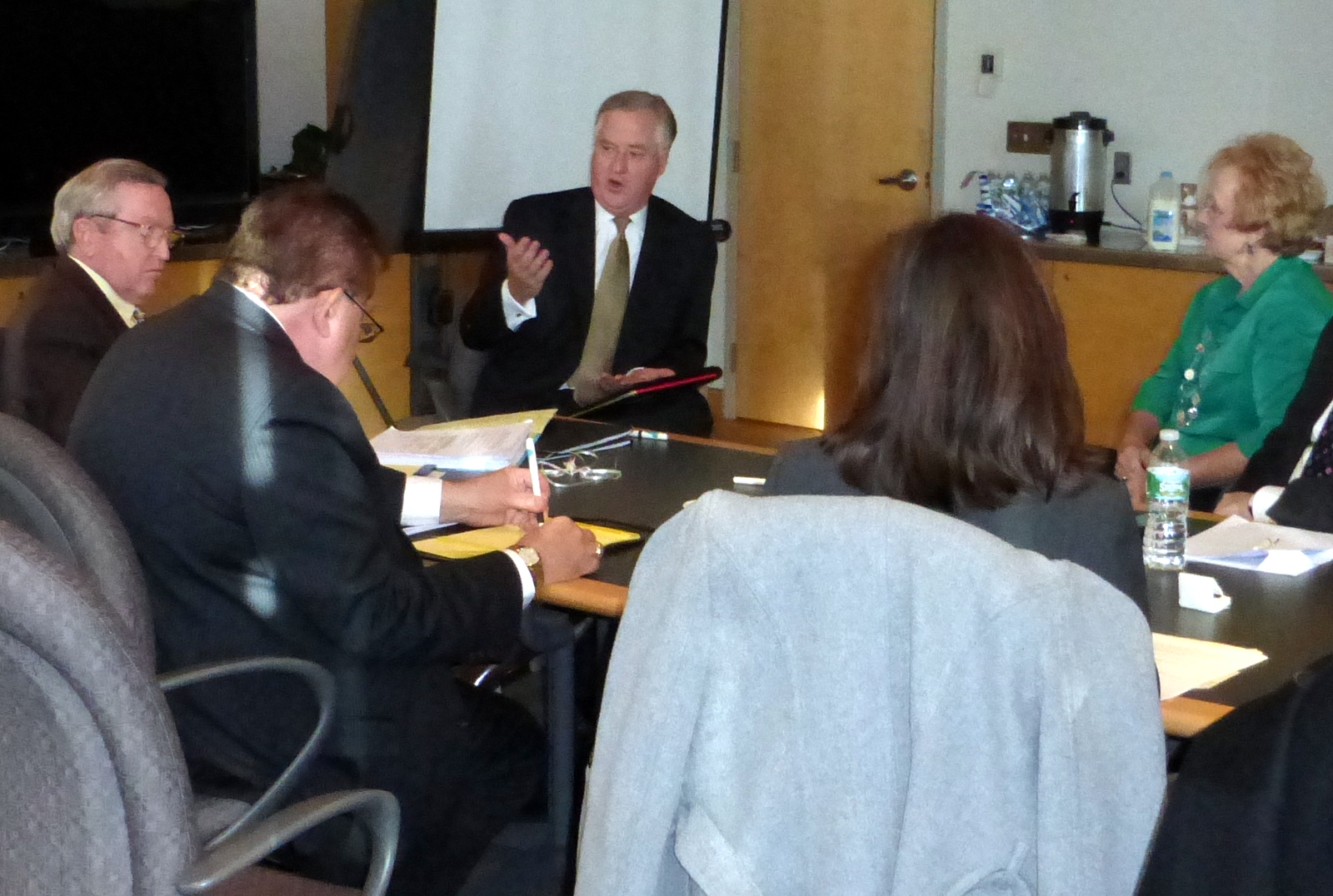
J. Brendan Sharkey (c), House Speaker, addresses today’s meeting of municipal leaders in Norwalk. (CLICK TO ENLARGE) WestportNow.com photo
“Board of Education members do not have to answer directly to taxpayers,” he told a meeting of municipal leaders in Norwalk. He suggested a separate tax bill for education –- which now dominates much of local spending—would prompt taxpayers to demand more education efficiencies.
Addressing a meeting of the South Western Regional Metropolitan Planning Organization (SWRMPO) at the Norwalk Transit District, Sharkey said local spending burdens could be aided by the state taking over special education costs and creating regional special education centers.
But he warned that this would be at a cost of $1.8 billion a year and that would result in an 18 percent increase in state taxes.
Darien First Selectman Jayme Stevenson responded that creating regional special education centers could impose unacceptable travel times on local residents and urged that the state move carefully on any such regional proposals.
Sharkey was invited to the meeting by municipal leaders from Westport, Weston, Wilton, Norwalk, Darien, New Canaan, Stamford and Greenwich to explain his push for consolidation of the state’s planning regions. The last legislative session mandated such consolidations by Jan. 1.
Last week, the South Western Regional Planning Agency (SWRPA) and the Housatonic Valley Planning Region received approval from the Office of Policy and Management to merge to form the Western Connecticut Planning Region.
The approval is anticipated to lead to formation of a Western Connecticut Council of Government once 60 percent of the member municipalities have endorsed the move. Westport is the only one of the eight SWRPA members to so far approve joining a Council of Government (COG).
The 10 members of the Housatonic Valley Council of Elected Officials (HVCEO) are expected to easily approve transforming into a COG since their governing structure already is similar to a COG. The HVCEO communities are Bethel, Bridgewater, Brookfield, Danbury, New Fairfield, New Milford, Newtown, Redding, Ridgefield, and Sherman.
Bethel First Selectman Matthew Knickerbocker, chair of HVCEO, was in attendance at today’s meeting along with fellow HVCEO CEO’s Newtown First Selectman Pat Llodra and Ridgefield First Selectman Rudy Marconi.
Sharkey repeated to the meeting what he told a September news conference in Hartford that the state’s tax system is “broken.”
“We have a complete mishmash,” he said, adding that it was his intention in the 2015 long legislative session to seek “a complete overhaul” of the state’s tax system.
Responding to a question from First Selectman Peter Tesei of Greenwich, Sharkey said he could assure municipal leaders that he was not intending to seek a uniform municipal tax rate across the state as part his regionalization push.
However, he said he would seek to authorize a statewide universal mill rate car tax. Legislation to eliminate the car tax did not pass the General Assembly in the last session. Sharkey said it was “unfair and regressive” to tax cars differently in Connecticut municipalities.
Sharkey said the concept of “responsible regionalization” was gaining support because “our local taxpayers are beginning to see what it costs to run local government.”
“We are leaving federal dollars on the table,” Sharkey said of what he called the state’s “mishmash” of various planning agencies, transportation, security, health, and mental health bodies with disparate boundaries.
At the same time, he said some local governments “have done an amazing job in finding efficiencies.” He pointed to an online building permit system already in operation in a number of Hartford-area communities using a centralized computer system.
Newtown’s Llodra and Wilton First Selectman William Brennan said labor agreements had frustrated their efforts to regionalize emergency dispatch centers.
“It’s so disappointing,” said Brennan of what he said were his seven years of efforts to consolidate Wilton’s dispatch center with neighboring towns such as Westport and Weston. “We know it can be done, but it’s got to be told by the state,” he said.
Sharkey acknowledged such inefficiencies and said the Federal Reserve Bank of Boston had identified multiple emergency dispatch centers in New England as the No. 1 government inefficiency in the region. But he said forcing such consolidations was fraught with complex political overtones that would likely meet resistance among legislators.
Asked how the state had addressed inefficiencies, Sharkey said there were 1,200 fewer state employees on the payroll now than in January 2011 and that there had been a 1 percent reduction in state operating expenditures. The state was also employing other means to produce efficiencies, he said.
Citing one effort as “very wonky and not sexy,” Sharkey said the state has already required state boards of education to switch to a uniformed system of accounting by June 30, 2015. This will enable an “apples to apples” comparison on education spending costs, he said.
He suggested that municipalities switching to such a system would also aid comparisons and increase pressure from taxpayers for more efficient spending.
At the outset of the meeting, Wilton’s Selectman Brennan was elected chair of the SWRPA MPO and Weston First Selectman Gayle Weinstein was elected vice chair. Brennan previously was vice chair.
Brennan succeeds former Westport First Selectman Gordon Joseloff, who was the MPO chair for the past two years and vice chair for two years before that.
MPO members at the meeting presented Joseloff, who did not seek reelection, with a certificate of commendation for his service.


If I understand this correctly, we can make our education boards more efficient by separating their budget/taxes from other town finances and regionalize special education “at a cost of $1.8 billion a year and that would result in an 18 percent increase in state taxes.”
I think of efficiency as being able to do more with less. Speaker Sharkey wants to do less with 18% more money. (regarding “less”: see below)
My understanding of “special” education means certain children need more individualized attention to help them learn according to their specialized needs. It would seem to me that pooling these children at a regional state school in Danbury or New Haven may neither be in the children’s best interest nor in the best interest of the communities. I may lean to the right on fiscal issues, but if I have to pay more taxes so that children with special needs can get the attention they need, I’ll be the first to stand in line. Westport isn’t perfect, but I much rather help them here than send them to some school of Hartford’s choosing.