

By Russell Diamond
Special to WestportNow
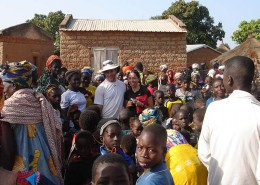
Russell and Mica Diamond (center) traveled to Africa in November to help build new schools. (CLICK TO ENLARGE) Contributed photo
My wife Mica and I recently returned from a week building a school in Mali. Not Bali. Not Maui. Mali. It’s a country about twice the size of Texas in Western Africa, and is a world away from Fairfield County.
A year ago we became active with a Stamford-based organization called Building with Books (BwB). Its mission is to motivate and empower American youth through after-school programs that instill ideals of community service and philanthropy.
BwB is active in 74 schools in mostly urban settings around the country. In addition to local service projects, participating students travel to developing countries to help build schools. Since 1993, BwB has built more than 150 schools in such far-flung locales as Nepal, Bolivia, Nicaragua, Malawi, and Mali.
The more we learned about the organization, the more impressed we became and the more eager we were to participate. We shared an interest in Third World poverty and knew we wanted to help be part of the solution. So we committed to building a school in Mali this past November. We raised the funds, got our shots, and flew to the capital, Bamako.
Our guides from BwB met us at the airport and escorted us over bumpy, dusty roads for four hours to the remote village of Bombala.
In the capital Bamako we could get by with French, but in Bombala only the native tongue Bambara is spoken. This put us at a distinct disadvantage, because neither of our high schools offered Bambara as a language option when we grew up.
But as we arrived the message of welcome was abundantly clear. The whole village turned out to greet us with an overwhelming reception of music, dancing, speeches (translated by our guides) and hospitality. The villagers were eager to have a new school in town, and were enthusiastic to build it.
The next morning we enjoyed another ceremony before the villagers signed a covenant to construct and maintain the school. While we provided the initial resources, the village promised the labor and upkeep, and the government pledged to provide the teacher and school supplies.
The village also agreed to ensure that 50 percent of the students would be girls and that children would be allowed to attend school rather than forced to work the fields.
Our presence in the village was fascinating, to us and to them. But once we picked up the shovels and picks the novelty subsided and the work was just plain hard.
One of the initial tasks was to dig the foundation, which was especially challenging given the ferrous, rocky terrain.
Concurrently there were teams of women carrying water a kilometer from the well. It’s pretty incredible to watch these women balance gallons at a time on their heads (no hands) while carrying a baby on their back. Mica attended to this task with them, and by the end of the first day she had worked her way up to carrying a kid’s beach pale with two hands while spilling only half.
The water then mixed with sifted sand to make cement for bricks. For purposes of quality control, there is one employed brickmaker, who oversees each of the 3500 bricks made one at a time.
After four hours of this each day, we were happy to return to our mud huts for a bucket shower of non-potable water dumped overhead (purse those lips), stepping carefully around a chamber that is also used as the latrine.
Our meals consisted of white rice, white potatoes, and some form of peanut oil sauce. In appreciation for the school, we were presented a sheep and some chickens, special treats that are eaten only on rare occasions. There were no green vegetables, but a few carrots, onions, and cabbage thrown sparingly into the stew. Although there was plenty to eat, some of the swollen bellies among the children indicated that nutritional problems persist.
Our afternoons were spent experiencing the different aspects of village life. We met with the elders, who act as the ruling council. The discussions became surprisingly in-depth and frank. They lamented that the land was yielding less and less each year, likely due to soil erosion and a lack of fertilizer.
They also reported that there were more mouths to feed. When asked if they could improve their lot by reducing fertility, they deferred that babies are God’s will and not theirs to control.
There are some traditional ways of thinking, especially among the elders, but they do crave development and recognize education as a key component. Education, especially of girls, has often proven to reduce fertility rates and ease the burden of limited resources.
As the week progressed, the experience transcended its original developmental intent and became downright personal. The children were eager to learn every English word we would teach them.
At one point Mica had a private sit-down with some women for a fascinating girl-talk session that revealed how it felt to live in a polygamous society. Such private moments were rare though, as we were usually surrounded by dozens of villagers.
Upon departure, we were treated to yet another outpouring of drumming, song, and ceremonial speeches. We took away that these were not primitive people, just very poor people.
They want healthier children and to live longer than their average expected 45 years. They are trying to get onto that first rung of the development ladder and were especially grateful for the help.
We were also encouraged by how willing they were to work to make it a reality for themselves and their children. We helped start the project, but it will be up to them to finish it over the ensuing months and to make it a success.
Our visit to Bombala had a profound effect on us, and was among the most rewarding things we’ve ever done. We are very grateful to our friends in Westport, whose generosity helped to make the school a reality. If you have an interest in doing a similar project, check out BwB’s Web site at buildingwithbooks.org, or send us an e-mail to get started.
Russell and Mica Diamond live in Westport with their two children and can be contacted at .(JavaScript must be enabled to view this email address).


