

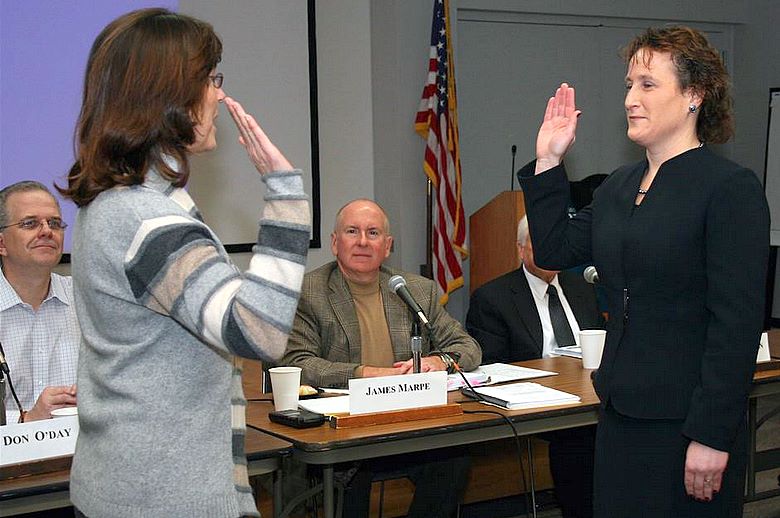
Elaine Whitney was sworn in today as a new member of the Westport Board of Education by Town Clerk Patty Strauss. The ceremony took place as the board held an all-day budget session at the Westport Public Library. Whitney, who holds an undergraduate degree from Yale and an MBA from Northwestern University, was co-president of the Long Lots Elementary School PTA. She succeeds Marjorie Cion, a Democrat, who resigned Dec. 1 when she was board chair. (See WestportNow Dec. 1, 2008) (CLICK TO ENLARGE) Dave Matlow for WestportNow.com
Sponsors
11 thoughts on “Elaine Whitney Sworn In as New Board of Ed Member”
Leave a Reply
Subscribe
Enter your email address to get WestportNow.com delivered to your inbox:
Powered by FeedBlitz
Of Interest


Support a classroom.
Build a future.
What's inside
Property Transfers
Arts & Leisure
Business
Community
Health & Fitness
Education
Politics
Real Estate
Sports

COVID-19 Info
Westport Info
Westport Weather
Westport Traffic
Of Interest

Westport YouTube
Social Media


Westport-Area Blogs
Suggest a Westport-area blog by sending email to: editor@westportnow.com

I hope maybe with the addition of Ms. Whitney she can put her fresh perspective and experience to work and focus on holding a no increase budget for the budget proposed by Dr. Landon.
Thanks John for your input…However, I was purely commenting on welcoming Ms. Whitney and hope she might help and focus on dealing with the immediate issue which is assisting to reduce a budget that so many other towns in Fairfield County would be envious of. Workforce/Affordable Housing is another issue all together for another forum.
Why would she do that? The number one priority of a school board member should be to uphold the current standards and continue to excel into the future. NOT try to support personnel cuts or increase class size due to reduced budget.
As it is with the new proposed budget, he has attempted to have a 0% increase in every non-personnel category except fixed cost items. Second, he has reduced 15.4 staff members for a total savings of $1,226,457. Still faced with contractual salary increases and other negotiated rates, Dr. Landon is looking at a 2.5% increase over last year
Just to clarify, an increase or decrease in your house value doesn’t change your taxes directly. If everyone’s value goes down 15%, then you still pay about the same taxes as before. It’s a little more complicated when you add in business taxes, but the concept holds. Your share of the tax burden only changes significantly when your house value changes relative to everyone else. This usually happens when the formulas change (eg beach areas vs inland valuation), after a renovation, or when a major reval changes the balance between business and residential assessments.
They still need to raise approximately $160,000,000. to keep the town running. So if property values go down, mil rates go up. Either way, you
Correct me if I am wrong (not that anyone here needs such an invite) but my property value can drop 15% (as I suspect it has) or it could go up 20%, but the amount of my tax bill would not change, at all – because my property tax is calculated using the assessed value, not some market-current value. Unless you have bought the house recently, or done some significant renovations recently (of the sort that involved the Building Dept.), your property tax bill will only change for one of two reasons: there has been a change in the mill rate, or there has been a townwide reval. Right?
As for John’s points regarding the school system and its ranking as one of the biggest draws to this town (one might even say it is baked into the resale value of our homes in town), I agree. If anyone is budget aware (as we should all be) please pay careful attention to the First Selectman’s ongoing and continuous plans to build various town-subsidized housing.
It might not have been clear in my post above, but I completely agree with the point that those of us who have the 10-1-2005 reval as the basis for our assessed values are overpaying property tax (because our properties are no longer worth what they have been assessed at). However, this is not unlike the more common and reverse of this phenomena, where a years-old assessment is in place in an appreciating market, and only those homeowners who recently bought are paying an accurately-calculated amount of property tax, while the rest of the town underpays. The next reval is set for 2010.
David, I see your point, however, one could argue that you were underpaying all those years in between valuations as home values increased each year.
On to the real issue at hand, are you and others who are opposed to the school budget cuts making your voice heard to the Board of Finance and BOE?
At the risk of getting everyone back “off topic” the premise that people who purchased their properties or renovated them after the 2006 revaluation are paying lower taxes then the rest of us is wrong.
Our tax assessments do not change when we sell
our houses. The buyer pays his taxes based upon the value of that property as determined by the Assessor’s Office as of the date of the last reval.
Otherwise, you could pay less taxes, in a declining
real estate market by “selling” your house to your
brother for the current market price.
When a Certificate of Occupancy is issued for a new home or for a property that has been expanded, the Assessor tries to determine what that new house or improved house would have fetched back in 2006 when he issues a revised assessment.
In a rising real estate market (before 2006) new McMansions were coming onto the grand list and were taxed not at the current arm’s length sales price but at the price a house of that size and quality would have sold for back several years ago.
This is the only way to insure that everyone pays against the same set of rules.
So Mr. Lasley and Mr Whittle do have it right. The 700 homes sold since 2006 are not paying lower taxes than the rest of us. The system described
by Mr Loffredo is applicable in some jurisdictions, just not Connecticut. He is not paying a higher share of taxes than our new neighbors.
Robert E. Grant
Not to beat a dead horse, but I saw this in Time magazine today (link at the bottom).
Why Does Your Devalued Home Have Such a High Tax Rate?
By PAIGE BOWERS / ATLANTA Saturday, Jan. 10, 2009
Are your property taxes rising while the value of your house falls? Join the multitudes of Americans who are in the same predicament. In Atlanta, home values have tumbled over the past year by as much as 12%, but an Atlanta Neighborhood Development Partnership study of high-foreclosure areas found that the owners of those properties would have had to pay an extra $70 million in taxes because of overvalued but official appraisals. In states from New York to Arizona, angry citizen groups are lobbying their state legislatures
I saw that, as well as an article in today’s WSJ regarding the same issue – taxpayers demanding revals. But (and forgive me for staying on the “off-topic”) even if Westport residents demanded some sort of immediate reval, and one was done, and let’s assume for the sake of argument all of our appraised values and assessed values came down 15% – we would not see any decrease in our individual tax bills.
Generally speaking, our town adopts a budget, and once we know this big number and net out funds we take in from other sources, we compare that net budget amount to the total assessed values of all Westport properties (the “Grand List”), and calculate the mill rate required to collect that net budgeted amount from the Grand List. So, even if we all had our assessed values dropped by 15%, (and assuming the budget hasn’t increased) you would see ZERO change in your tax bill.
Here is the nice little explanation from the T of W website:
“Once the budget is approved, all outside estimated revenues (ex. state grants, fees, etc.) are deducted, leaving the balance that must be raised through taxes. This is the Tax Levy. The total amount of the Assessed Value of all taxable property called the Grand List is divided into the new Tax Levy providing the new mill rate.”
The moral of the story? Focus on the budget, and ALL expenditures in said budget – that’s what drives your tax bill.