

By James Lomuscio
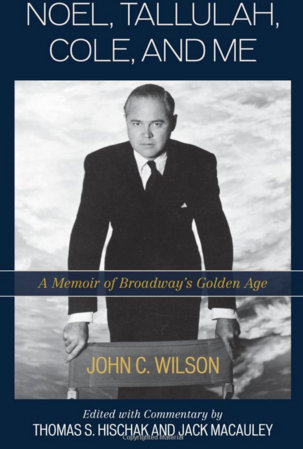
The book provides an inside look into the life of the man who ran the Playhouse from 1941 to 1957. (CLICK TO ENLARGE) Contributed photo
For Jack Macauley, it was happenstance, if not fate, when in 2012 he stumbled on to a box in a closet in his late parents’ home. It turned out to be a treasure chest of sorts, providing a unique window into the Westport Country Playhouse’s past—and the town’s overall arts history.
The box he explored as he cleaned out his parents’ residence at Meadow Ridge in Redding teemed with theater memorabilia. It had belonged to Macauley’s mother, and all of it revolved around her favorite uncle—Broadway producer John C. “Jack” Wilson.
Wilson, who died in 1961 at the age of 62, had produced 45 shows on the Great White Way, including “Kiss Me Kate” and “Gentlemen Prefer Blondes.” A resident of Southport, he also served as managing partner for the Westport Country Playhouse from 1941 to 1957, coming aboard 10 years after it was founded.
His influence on the theater world, actors and playwrights (at age 26 he and playwright Noel Coward became lovers) is retold in “Noel, Tallulah, Cole, and Me: A Memoir of Broadway’s Golden Age.”
Macauley, Wilson’s great nephew, and Thomas S. Hischak, a renowned performing arts author, historian, and teacher, edited Wilson’s unpublished memoir found in that memory box. The 281-page hardcover was published in October by Rowman & Littlefield.
“I found the manuscript,” said Wilson, a Wilton resident. “It would have been the equivalent of a ready-to-go- draft, 200 single-spaced pages.”
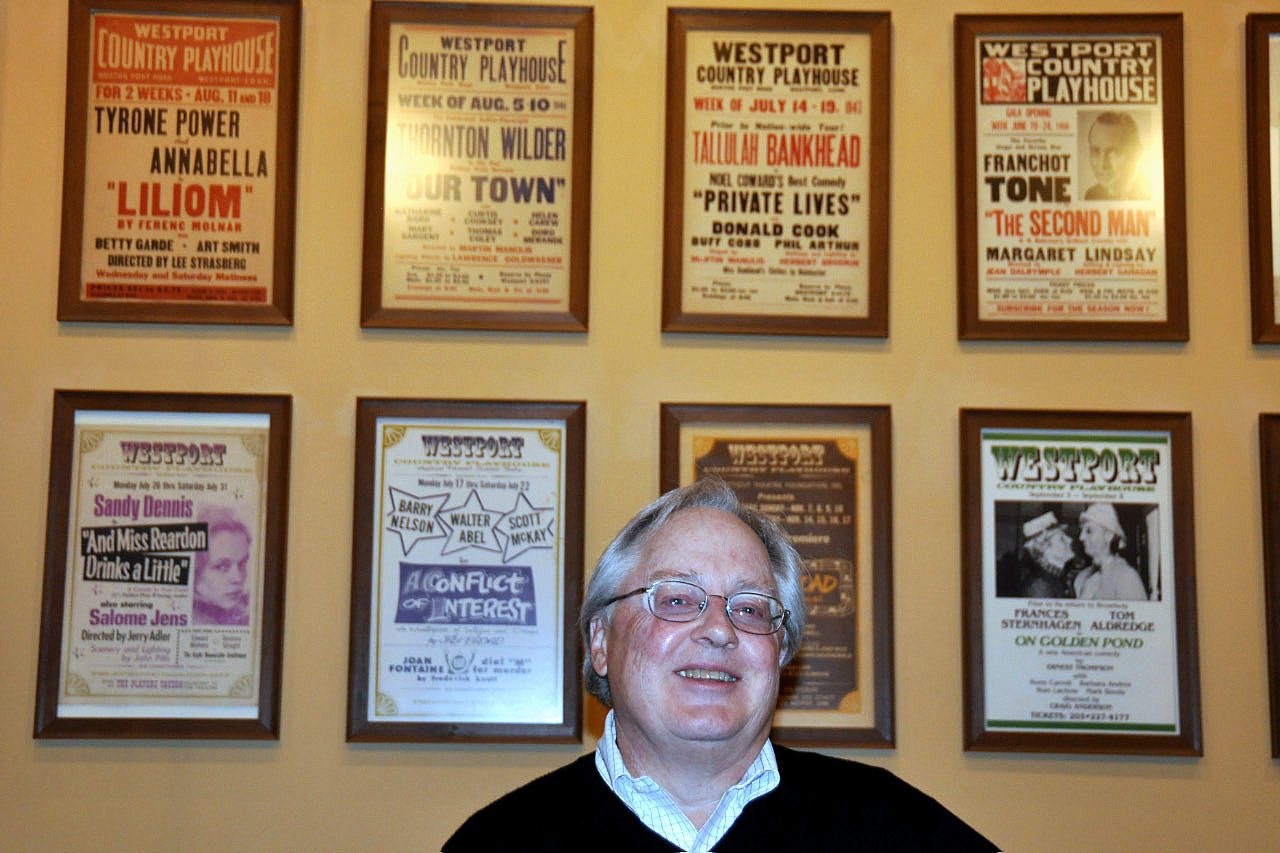
Jack Macauley on a recent visit to the Playhouse. (CLICK TO ENLARGE) Phyllis Groner for WestportNow.com
He and Hischak worked on the project for two years, editing and enhancing the text with call outs and actor information boxes “for lesser known actors, even well known ones such as Marlon Brando, Carol Channing and Tallulah Bankhead.”
When Wilson took the Playhouse helm in the summer of 1941 after being hired by founders Lawrence Langner and Armina Marshall, Bankhead was his first headliner. She starred in “Her Cardboard Lover” by Jacques Deval. That same summer, Tyrone Power starred in “Liliom” by Ferenc Molnar.
The Playhouse was closed from 1942 to 1945 during World War II, but reopened in 1946 with other state luminaries: Olivia de Havilland in “What Every Woman Knows,” and longtime Fairfield County resident June Havoc in “They Knew What They Wanted.”
Scores of other actors, including Lillian Gish, Christopher Plummer, Maureen Stapleton, as well as lesser known ones, seemed to have cut their teeth at the Playhouse under Wilson’s direction. In 1948, he directed Thornton Wilder’s “The Skin of Our Teeth,” which earned Wilder his equity card, according to Peter Chenot, the Playhouse’s director of marketing.
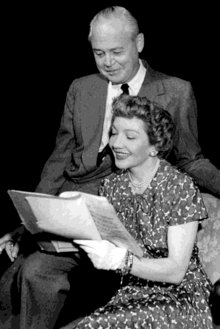
John Wilson and Claudette Colbert at the Playhouse in 1951. He had trouble finding her an acceptable place to stay. (CLICK TO ENLARGE) Contributed photo
In 1951, Wilson convinced film star Claudette Colbert to come to Westport to star in Coward’s “Island Fling.”
“Although her performance certainly made the trip worthwhile,” writes Wilson, “she presented a few rather distressing domestic difficulties.”
He explained, “since there were no hotels in Westport proper in those days,” he drove Colbert first to Longshore Country Club, “an elaborate establishment with an eighteen-hole golf course and cottages facing Long Island Sound.”
However, that proved unsatisfactory to Colbert. “Claudette had certain objections and decided against it,” Wilson wrote. Also rejected was Cobbs Mill Inn in Weston. Stonehenge farther afield in Ridgefield proved acceptable until “a lady sunning herself on the lawn asked her for her autograph. That did it, and off we went again.”
She eventually stayed in a wing of a private home, Wilson said.
On a recent morning visit to the Playhouse, at a time when the theater was empty, the lights off in the lobby, Macauley stared up at all the posters, looking at all the ones his great uncle brought to the stage. It was almost as if he had stepped back to a golden age, courtesy of that box.
Not only happy about the book’s release, Macauley said that all of the boxed material from old photos and playbills since have been given to Wilson’s alma mater Yale and are now at the Beinecke Rare Book and Manuscript Library.


