

By James Lomuscio
Westport Board of Finance Chairman Brian Stern said tonight that a “modest” tax increase is likely despite the fiscally responsible proposed town and school budgets.
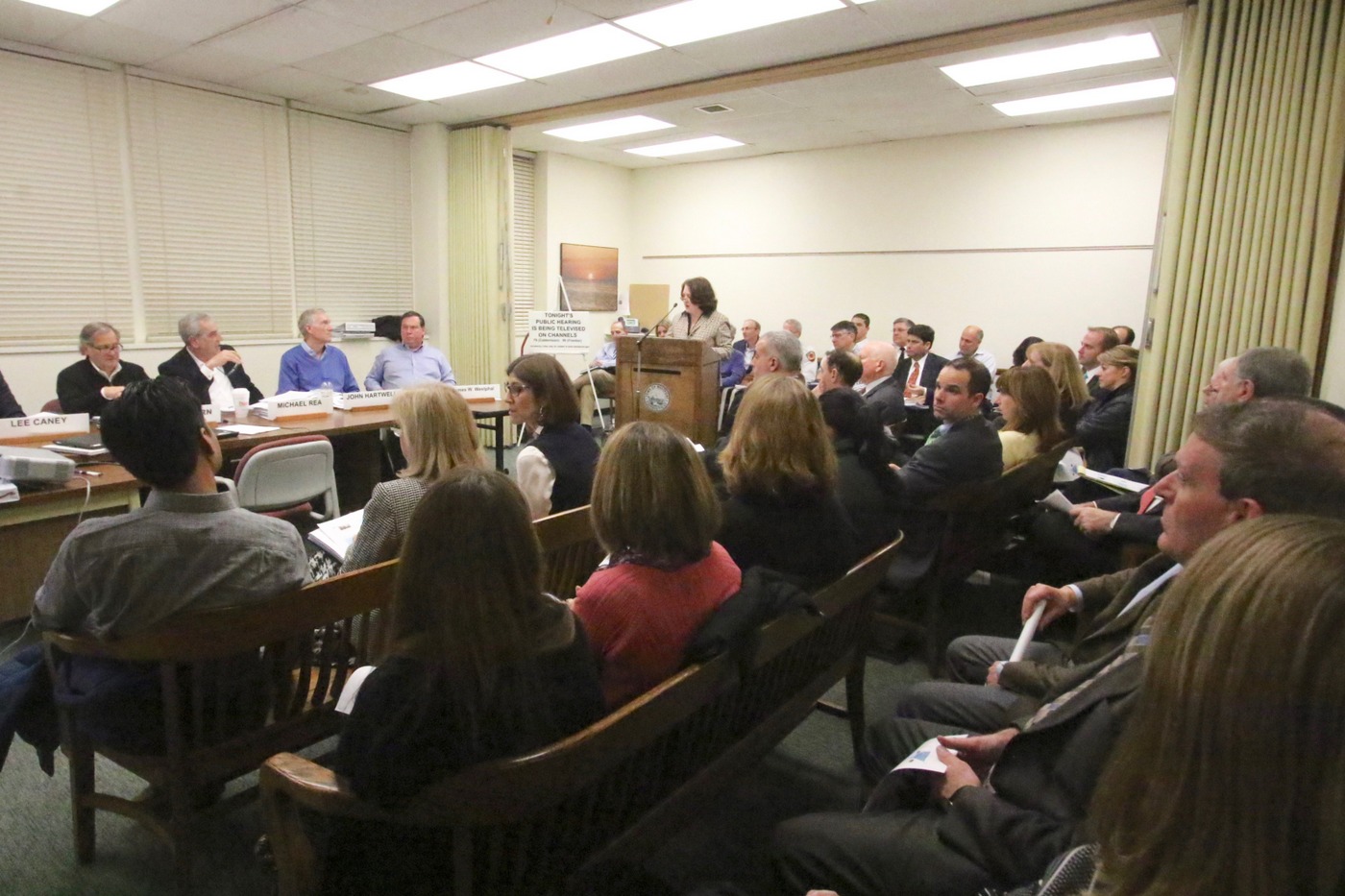
There was a full house for tonight’s Board of Finance meeting with some town employees and others forced to watch on TV in the Town Hall lobby. (CLICK TO ENLARGE) Dave Matlow for WestportNow.com
“I do think we will have a modest tax increase in the fall,” he said after hearing details of the budgets tonight.
The reason? Stern only had to point to Hartford, and harsh words flowed.
“Hartford should quit asking us to fill the gap for their own ineptitude,” Stern said about Gov. Dannel P. Malloy’s plan for towns to pay one-third of teacher pensions.
That potential liability translates into an extra $5.9 million per year here, $8 million when tallied with $2.1 million in state cuts to Westport for next year.
“I’m hoping it’s zero obviously,” Stern said of a tax increase. “But I don’t think the town can absorb all that cost in one year -– that will be a little much to do.”
“We don’t know where we stand so late in the cycle,” he said. “This is new for us, this uncertainty.”
State Rep. Jonathan Steinberg, who was present at the meeting, offered some comfort.
He said that many of his colleagues oppose Malloy’s plan, and that it will most likely not make it into the state budget when it is finalized in late August or September.
Still, the threat of local liability loomed.
Public schoolteachers in the state’s Teacher Retirement System contribute 6 percent of their salary, and the state covers the pensions 100 percent for each of Connecticut’s school systems, an amount reported to be about $1.2 billion this year.
Next year Malloy, staring down a $1.7 billion state deficit, wants towns to pitch in $407.6 million, $420.9 in 2019.
Affluent towns like Westport that pay teachers higher salaries than other towns would be hit hardest, having to contribute more to retirement.
“The threat from Hartford is very real and very large,” Stern said.
He compared the additional cost to Westport over 20 years to building a new Staples High School or Bedford Middle School; doubling the size of the Police Department; or having the Department of Public Works respond to 160 snowstorms six inches high “every year going forward.”
“They are making bad decisions on a crisis-to-crisis basis,” Stern said. “It’s a transfer of a liability from the state to the town.
“This is the audacity,” he added. “They made a full frontal attack on our school system.”
All the doom and gloom was in stark contrast to the municipal and Board of Education budgets that had been hammered out over the past six months and presented tonight.
Malloy’s proposal notwithstanding, First Selectman Jim Marpe touted a total town and school budget of $206 million for 2017-18, a .59 percent increase over the current year.
Of that total, the town’s $79 million proposed budget represents a 1.44 percent decrease from 2016-17. The $115,351,346 proposed school budget presented by Superintendent Colleen Palmer is a 2.44 percent, or $2.7 million, increase.
But with state uncertainty, Westport’s budgets will have to be malleable. The finance board has scheduled a meeting for Monday, March 6, to consider ways to deal with the cuts and possible added expenses.
The Board of Finance is also scheduled to pore over both budgets from Tuesday, March 14, through Thursday, March 16.
After the finance board’s approval, the budgets will go to the Representative Town Meeting for final approval, so the budgets can be in place by June before the start of the new fiscal year July 1.
One idea Stern floated for finalizing the budgets is to assume no money would be coming to Westport from the state. That means planning for a $4 million shortfall and a possible 2 percent reduction across the board.
That amount, however, does not include a possible $5.9 million extra for teacher pensions.
”We have to have a budget in place,” he said. “We must have a budget in place, and we can adjust it with a tax change.”


