

By .(JavaScript must be enabled to view this email address)
Experts and residents discussed affordable housing tonight at a Westport Town Hall meeting and many agreed that they know what is needed to garner support to move forward to erect such housing. 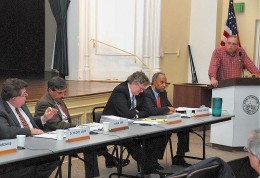
Floyd Lapp (l), executive director of the South Western Regional Planning Agency, responds to a question from Westport Planning and Zoning Commission member Davic Press (at podium) during tonight’s Town Hall meeting on affordable housing. (CLICK TO ENLARGE) Jennifer Connic for WestportNow.com
For almost three hours, experts suggested ways to provide more affordable housing and responded to audience questions and comments during what was billed as a “Citiizens Summit on Affordable Housing.”
First Selectman Gordon Joseloff, who organized the meeting, said affordable housing is an issue of paramount concern.
“We need to constitute it in a manner that is in a good location and that is of a density that is good for the neighborhood,” he said.
David Fink, policy and communications director for Hartford-based Partnership for Strong Community, said there has been an increase in the number of communities where those earning the median income cannot afford the median priced housing.
In 1994, it happened in 102 out of 169 cities and towns in Connecticut, he said, and in 2005 it was happening in 157 cities and towns.
While workers could be drawn from other communities to a wealthier community like Westport, he said, that is less likely to happen today.
There are no starter homes any more, Fink said, and builders are constructing housing for senior citizens and large McMansions.
Land costs are high, he said, so it is not financially viable to build a starter home.
Floyd Lapp, South Western Regional Planning Agency executive director, said there should be a model where zoning regulations require 20-25 percent of units in a project to be restricted to be affordable.
Additionally, there should be zoning bonuses to permit higher density when a developer proposes affordable housing, he said.
Westporter Ross Burkhardt (l) makes a point during tonight’s affordable housing summit at Town Hall while moderator Steven Daniels of Westport listens. (CLICK TO ENLARGE) Jennifer Connic for WestportNow.com
Modular homes should be used because they would cut down on construction costs, Lapp said, and developments should be transit-oriented and located within a five to 10 minute walk from a train station.
Accessory apartments should be legalized, he said, and there should be multi-family homes that are in the style of townhouses and rowhouses.
Westporter Ross Burkhardt, president and CEO of New Neighbors, Inc., a Stamford-based nonprofit community development corporation, said the parking lots at office developments are empty at night.
Those areas should be used for housing to share parking, he said, because one of the biggest problems in construction of affordable housing is finding adequate parking.
Rick Redniss, president of the Stamford-based land planning and consulting firm Redniss and Mead, said the edges of places like corporate parks are good places for affordable housing.
Part of the problem is that when land becomes available, it’s hard for a community to react and buy it and set up housing, he said.
“By the time they can do something, someone in the private sector can swoop in,” Redniss said.
Several audience members complained that while there have been many suggetions on ways municipalities can succeed in constructing affordable housing, it hasn’t been done.
David Press, a Planning and Zoning Commission member, said that when running for office people often ask questions about affordable housing at the candidate forums.
Despite the questions, however, the same problems still exist, he said.
“We need the will to move it along,” Press said. “It’s frustrating because we pass the zones and then there are no bricks and mortar.”
Joseloff said while there was a lot of talk about the issue tonight, he would like to see action taken.


