Sunday, October 18, 2026

Sponsors

Education

BOE Votes to Delay School Start Times

After lengthy discussion, by a vote of 5 to 2, the Board of Education tonight recommended delays in school start times beginning with the 2020-2021 school year.

Staples High School will go from a 7:30 a.m. start to 8 a.m., Bedford and Coleytown Middle Schools to 8:30 a.m., Saugatuck Elementary 8:30 a.m., Coleytown, Greens Farms, Kings Highway, and Long Lots Elementary Schools to 9 a.m. and Stepping Stones Preschool to 9:30 a.m.

Members Karen Kleine and Elaine Whitney voted against the proposal. They favored further consideration.

Talk Tells Parents to Tame Their Interloping

She said that children are not bonsai trees to be groomed and controlled, but “wildflowers of an unknown genus and species, and it’s (our) job to provide a nurturing environment.”

Tracey Masella, a social worker with Silver Hill Hospital, a nonprofit psychiatric hospital in New Canaan, led the talk and short question-and-answer session with close to 200 parents.

The program was also presented on Tuesday afternoon, with more than 200 parents in attendance as well.

With taking one’s life representing the second highest cause of adolescent death, and millions of young people experiencing high levels of anxiety and depression, Masella described a “public health emergency” traceable — in part — to parental and related peer pressures for success and high achievement.

In the process of trying to cultivate high achievement through various kinds of micromanagement, Masella said parents are simultaneously robbing their children of opportunities to develop life skills, as well as emotional intelligence.

In the video Lythcott-Haims described this “certain kind of parenting,” which is the opposite of neglectful but goes way too far in the other direction.

“Parents feel a kid can’t be successful unless the parent is protecting and preventing at every turn,” she said, “and hovering over every happening and micromanaging at every moment.”

“All of this is done for some hoped-for degree of perfection,” she said. “We expect our kids to perform at a level of perfection we were never asked to perform at ourselves.”

Consequently, she said, kids are burned out — “withering” — and some are even wondering if this life will turn out to be worth it.

Masella shared background on brain development of young people, which she noted wasn’t generally equipped for all the weight and responsibilities put upon it.

“Their schedules are like some heads of state … with a CEO that’s not even out of elementary school,” she said.

“All of this is because we want them to be what we consider successful,” she said.

And because it’s what she called a flawed system enveloped in a dream of perfection that the parents maintain, when things go awry as they ultimately must, parents then intervene and attempt to fix all their problems for them, regardless of the cost.

“The kid learns a very valuable lesson — somebody is going to solve my problems for me,” Masella said sarcastically. “If I squeak loud enough, somebody other than me is going to come in and take care of me.”

Masella said it’s never too late to start sending a new message to one’s children, though as they get older it becomes more critical to listen to them, for random “teaching moments” from parents make way for peer influence by their midteens.

One of the key elements, she said, is demonstrating the values you want to instill through action.

“I hear all the time parents say, ‘I don’t care what my kid’s grades are,’” Masella said, “’as long as they try their best.’”

She said, however, that if you really mean that you shouldn’t go on the school website on a daily basis — or multiple times a day, as many parents do — to check grades and homework.

“That’s putting your money where your mouth is,” she said.

Parents, she said, will also do well to express less interest in school and more in their children themselves, showing them love and real acceptance.

“What’s the one thing we talk to our kids about the most?” she said. “School. What’s the one thing they don’t want to talk about?”

Masella highlighted other elements of wellness, including sleep.

“We are depriving our kids, as a society, of sleep,” she said, noting the impact on attitude, including anxiety, is corollary.

She also put in a plug for unplugging, even for 30 minutes a day, and highly recommended letting the whole household become “like a monastery” at least for a small part of each day to augment mental health.

Second Selectman Jennifer Tooker helped introduce the program, noting that she constantly hears questions from constituents about how the community can address various issues facing young people.

“We want you, our residents, to know that these are not easy topics to tackle,” she said, “and really it takes a village.”

Allison Keisman, a co-chair of the PTA committee, said the purpose of the talk was “to raise awareness and spark a new parenting movement in Westport.”

She told parents that if the community at large is able to shift its mindset and rethink the culture as it stands, “maybe you’ll start to watch yourself in overparenting moments.”

Primary Teachers Oppose Changes to School Start Time

She said elementary teachers were not brought into the discussion, but would argue against the move.

She said elementary attention spans are much better in the morning, and tend to diminish by 2 p.m. because the youngsters are tired.

“I ask that you have elementary teachers there to share their thoughts, ideas and concerns,” said Deb Goldenberg, an art teacher at Coleytown Elementary School (CES).

“Students are more focused in the morning,” said Erika DiGiovanni, a fourth grade teacher at CES.

“I fear that the high level of learning that we value in our district is in jeopardy,” she said.

Concern was also expressed about the impact the change would have on working parents, who might need care in the mornings for their kids.

“It fails to address the impact it will have on our youngest population,” parent Sofia Dumery said of the proposal.

BOE member Karen Kleine likewise expressed skepticism about the change, in particular not convinced it would have any impact.

“I would love to see us measure results … because I personally don’t think we’re going to see any,” she said, noting that not all youngsters have trouble getting up in the morning.

“I don’t want to put this out there like it’s some kind of magic cure-all,” Kleine said, noting results in Wilton from a similar change did not appear to be helping students.

Superintendent of Schools David Abbey spoke on behalf of the change, explaining that the district should look into possibly creating some morning programs for students that can take place before school.

“I think the proposal is an important one,” he said, calling it less an educational issue than a community one.

He said there was no reason elementary students could not shift to a later time, provided teachers handled the pacing in such a way as to keep a balance.

Abbey said evaluating the change would make sense, and suggested it could be as simple as interviewing students about its impact.

“You might want to just ask the students if it’s made a difference,” he said. “Have they slept more?”

Christine Meiers Schatz, a member of the Representative Town Meeting and parent who spearheaded the proposal and helped form the committee, defended its work in terms of examining the impact on elementary-age students.

She said both elementary parents and administrators served on the SSTC, which unanimously endorsed the recommendation.

“There’s nothing to indicate that moving to nine o’clock, from what I’ve seen, would be to the detriment of our elementary schools,” she said.

Saugatuck Elementary School parent Jen Berniker spoke in favor of the change, as her school starts at 8 a.m., and not 8:30 a.m. like others.

“I’ve just been praying for this,” she said.

Berniker suggested that if students are tired toward the end of the day, maybe it’s because the day is too long.

“Our elementary school is much longer than any of us grew up with,” she said.

Reflections Winners

WestportNow.com Image
Westport students came up winners in the Reflections Program, a national PTA art contest. Each of the student artists won at the school level, and their work, based on the theme, “Look Within,” is moving on to be judged at the state. Pictured are the Bedford Middle School winners (l-r) with BMS Principal Adam Rosen, Jonathan Costello, Ryder Levine, Scarlet Gerber, and Courtlyn Crombie. Staples winners included Dylan Goodman, Caelin Reilly, Henry Schwabe, Clara Holleman, Nathaniel Kolek, and Juliette Savarin. (CLICK TO ENLARGE) Contributed photo

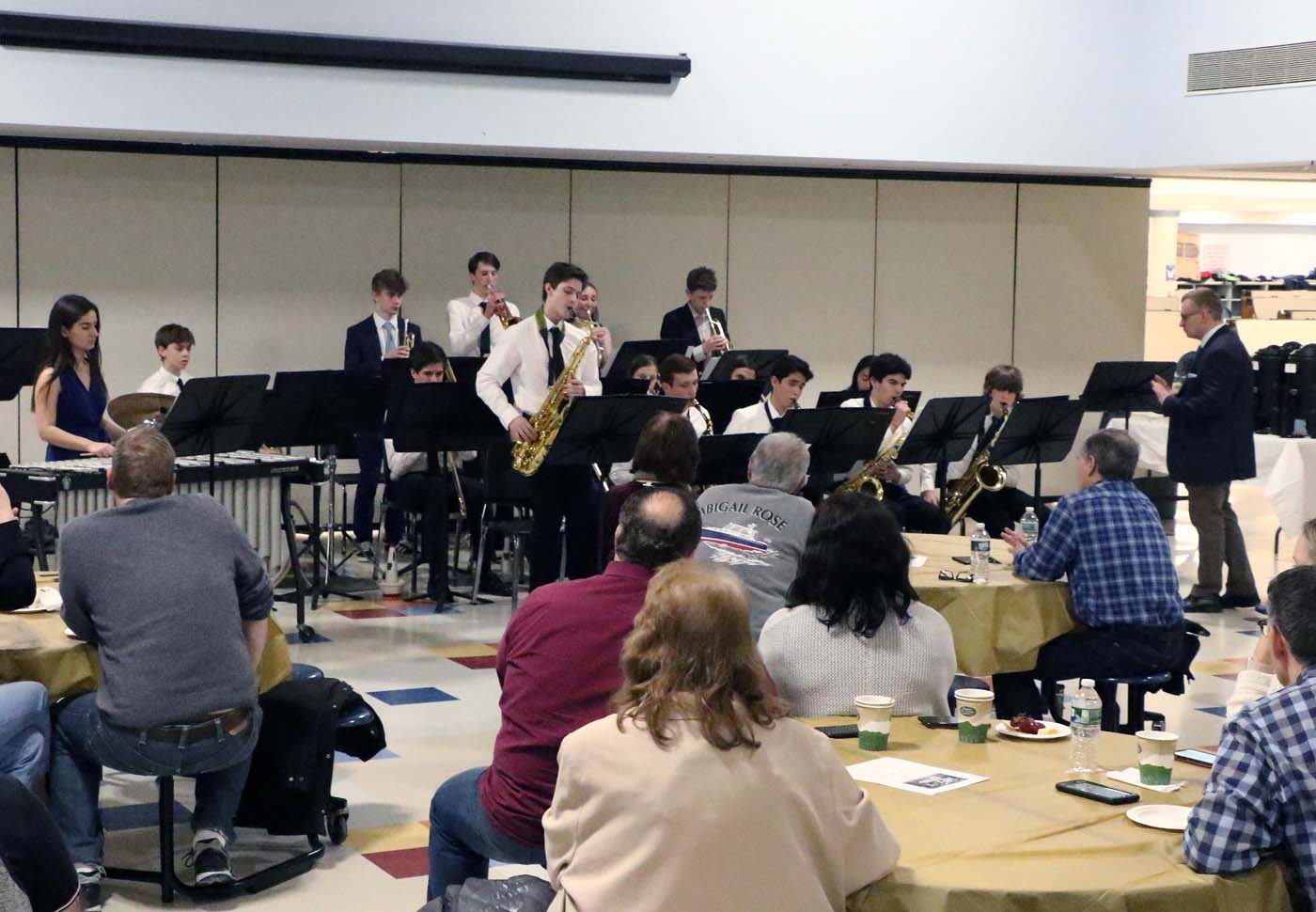
Cafeteria Jazz

WestportNow.com Image
An overflow crowd at Staples High School tonight was treated to a winter jazz concert, titled “Jazz and Java.” According to first year music director Phil Giampietro (r),“Our brand new student-led combo and our jazz ensemble performed in a less formal ‘coffeehouse’ setting.” Giampietro told the attendees, “It is the first performance of the year, and it is a sort of preview performance for the jazz festivals and competitions coming up in March.” (CLICK TO ENLARGE) Dave Matlow for WestportNow.com

CMS Principal Returning to Work Wednesday

Following an investigation, the state’s attorney agreed to not pursue Szabo’s case due to her clean record. If she stays out of trouble, her case will be dismissed.

According to news reports, Szabo, 49, allegedly slapped a 71-year-old man in a dispute over a parking space.

Szabo has been principal of CMS since 2004. She has been working at Bedford as a “principal on special assignment,” while CMS is undergoing renovations.

Prior to Westport, she was principal for five years at Griswold Elementary School.


BOE Questions If Budget Cuts Go Too Far

“We face unique challenges this year,” he said, noting that reopening Coleytown Middle School (CMS) next year accounted for around $800,000 of the increase.

“The community has embraced two middle schools,” he said. “There are costs associated with it.”

Insurance costs are up about 10%, he said, and that accounts for about $1.5 million of the total $4-million increase.

“Our budget (increase) this year would be at 1.54%,” he said, without those two items.

“We had to take a look at staffing and a deep look at staffing,” Abbey said, “and that is not an easy thing to do.”

Abbey proposed an overall reduction of 8.6 full time equivalents (FTE.) He said this equation starts with a 18.1 FTE reduction comprised of 9.6 certified and 8.5 noncertified, coupled with a 9.5 FTE addition of staff Abbey said are necessary for the reopening of CMS.

Other cuts included staff development funding and stipends, facility improvements, and tech equipment.

“The current budget is a lean budget … It’s not a budget that allows for a great deal of latitude,” Abbey said.

Several science educators were in attendance speaking on behalf of their programs, along with some parents and town officials.

“The program design is what makes Westport a leader in elementary science,” said Mary Purcell, science coach at Coleytown Elementary School.

“Our passion led to this innovation,” said Phaedra Taft, science coach at Greens Farms and Long Lots Elementary

“If this were to be cut you’d be stopping a pioneering program,” she said, noting she was involved with its inception and that this would amount to dismantling all their work.

Mark Friedman, District 3 member of the Representative Town Meeting (RTM), said he understood the BOE was trying to balance its budget, but felt it was going too far.

“We’re starting to impact some of the things that make the Westport schools very special,” he said.

“I’ve heard the phrase, ‘We can make this work.’ That’s not inspiring to me … Making it work is not the same as making things great,” he said.

“I’m really disappointed to see this up there,” said Lauren Karpf, RTM District 7, sharing about the impact the program has had on her children.

“The reality is that there is an impact for many or all of these cuts,” said Anthony Buono, assistant superintendent of teaching and learning.

Following inquiries, several BOE members raised the question of Abbey’s choice to keep spending $90,000 for bus monitors, which are used on the elementary routes where students board and exit from busy roads.

“For me it’s an issue of safety and security,” he said, referencing the 1991 incident in which an eight-year-old student named Holly Finley, living on Evergreen Avenue, was dragged beneath the school bus and killed after her backpack caught on the handrail and the driver shut the door and pulled away.

In 2012 there was a very similar near miss. A boy’s backpack was caught and the Dattco driver pulled off without checking that he was clear of the bus. Fortunately the driver saw him at the last minute and stopped the bus.

“There are people who have different views than mine,” Abbey said, but indicated he would like to see monitors on all the buses.

“We’ve been told there are no other districts in America that have these,” BOE Vice Chair Jeannie Smith said.

“I would make a motion to add back in the science coaches, personally,” BOE member Karen Kleine said.

BOE Secretary Elaine Whitney said traditionally the board holds discussions on items to be reinstated or new additional cuts, and then votes by section.

She prepared a list that included several items for possible reinstatement to be discussed next week, including the science coaches, as well as the possible new cut of the bus monitors.

“I would love for the board to take a position of increasing money back in,” Abbey said, noting that if they want to keep the increase below 3.5 % it would mean staff cuts.

Kleine noted recent comments by First Selectman Jim Marpe, in which he touted the town’s financial reserves.

“Our reserves are in very good shape … That’s something we need to repeat,” she said.

“Why it’s necessary for us to go to this number, I don’t understand it,” she said.

State of Town and Schools Strong But With Challenges

“The state of the Westport Public Schools is strong and getting stronger,” she said citing state and national laurels for its STEM program, new, elementary level math and science curricula and the schools’ increased focus on students’ social and emotional health.

“But, we should never rest on our laurels,” she added.

The biggest challenges for the schools—and by extension the town —is the scheduled reopening of the $32 million renovated Coleytown Middle School (CMS) in late August and its effect on the annual budget cycle.

“The budgeting processes are intense this year,” Savin said, adding that “unfortunately we have no such circumstances this year” to have a similarly lean, 1.79% budget increase as last year.

When asked about the town’s biggest budget challenge, Marpe said that while there will be tradeoffs in the capital forecast, “I’m actually pleased with our operating budget.” He added that municipal department heads have done their due diligence to keep department budgets down.

One audience question presented by Jeffrey Wieser, deputy moderator of the Representative Town Meeting (RTM), asked Savin what the strategy would be if CMS were not operational by the fall.

“There are a few scenarios,” she said, saying that “if something crazy happens” the schools would continue next year as this year, with CMS students attending Bedford Middle School.

Among some of the challenges for the town, Marpe said, are traffic “because of our location and the presence of two, major limited access highways and Route 1,” making Westport a pass-through community.

“I will be scheduling specific RTM district public meetings to try to identify practical, realistic solution to the local traffic problem,” he said.

Marpe also said that affordable housing “continues to be a challenge for Westport because of the limited amount of undeveloped space in our community.”

He lauded the four-year moratorium the town has to address the problem in the wake of the state’s affordable housing statute, 8-30g, which allows a developer to override local zoning laws if a municipality does not have 10% of its housing stock deemed affordable, which Westport at 4%, does not.

“During that time we have the opportunity to guide the development of affordable housing that respects our neighborhoods while addressing the realities of our affordable housing obligations,” he said.

On other topics, Marpe was asked about a controversy involving the Westport Museum for History and Culture, formerly known as the Westport Historical Society (WHS). The museum recently removed the Sheffer family name from its gallery following a gift from the estate of a Weston man, Daniel E. Offutt III.

Marpe said the museum was not unlike other nonprofits in town and the town did not involve itself in the internal affairs of such institutions. “That’s not really for us to do,” he said.

The first selectman acknowledged until several years ago that the town paid the WHS for storage of records but that was no longer the case.

He said the town had contributed to the museum’s New Year’s Eve effort known as First Light, which replaced the First Night but was not happy to learn that some of the town funds went to paying museum salaries. “We will make every effort to recover” those funds, he said.

Marpe capped his remarks about the controversy by saying he was not happy with some comments about the situation made on local blogs.

“The tone is not what Westport should be about,” he said, and adding that some of the comments were akin to cyberbullying.

As part of Westport’s efforts to improve the environment, Marpe said he would soon be announcing a “2020 Zero Food Waste Challenge” in which residents would be asked to reduce the amount of wasted food thrown away.

On the subject of finding a replacement for Joey’s by the Shore at Compo Beach and the concessions at Longshore, Marpe said the town was reviewing bids submitted by a new operator and hoped to have at lease a limited food concession business in operation by the beginning of the summer beach season.